
Sci-tech Backyard Makes Brazilian Agriculture Smarter
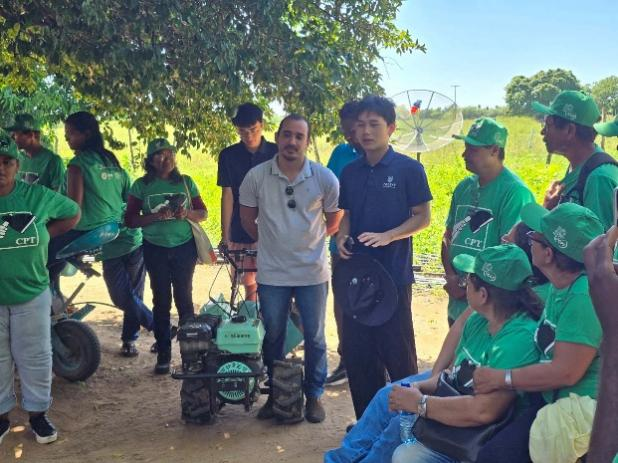
On a typical morning at the Fazenda Água Limpa (FAL) on the outskirts of Brasília, Brazil, the crops are thirsty. FAL is a 500-hectare experimental and educational farm that is a university-run research project. In a nearby workshop, agricultural expert Sergio Sauers monitors real-time data of the fields on his screen. He swiftly draws an irrigation zone, sets a 25-minute timer, and clicks "start" to activate the irrigation equipment in the fields.
This is a snapshot of daily operations at the "Sci-tech Backyard (STB)" for smart agriculture jointly built by China and Brazil. To date, over 400 hectares at FAL, about 200 hectares in Apodi municipality in northeast Brazil, and nearly 133 hectares in the city of Londrina in southern Brazil have been transformed into smart demonstration zones. Chinese-backed solutions have nearly doubled the efficiency of large-scale corn farming.
The backstory was one of real struggle. Nearly five million family farms across Brazil, mostly in the north, were long trapped in low-efficiency cycles — plowing with oxen, hauling with donkeys, and relying entirely on muscle power. Mechanization was a distant dream, and digital farming almost unheard of.
Around 2020, some farmers started looking eastward for solutions. In early 2024, China's Sinomach Digital Technology dispatched a dedicated team deep into Brazil's agricultural heartlands to assess local practices and infrastructure, map out the core needs of family agriculture, and build a bridge among governments, universities and enterprises.
By November of that year, with backing from China's Ministry of Education and Brazil's Ministry of Rural Development, the China-Brazil Joint R&D and Technology Transfer Center for Family Agriculture Mechanization — better known as STB — was launched in Brasília and Apodi.
Then the magic began. Chinese and Brazilian researchers rolled out the "Smart Farm Management Platform" on pilot farms. IoT sensors began monitoring the temperature, humidity, and pest activities, while BeiDou base stations relayed soil data from the intelligent machinery working the fields.
Farm managers now tap and swipe on their phones or computers as if playing a mobile game — plowing, tending, scheduling, and harvesting all flow through a single digital nerve center. The result are tangible: Input and labor costs have dropped by eight to 12 percent, while corn and sugarcane yields have climbed six to 10 percent.
Yet the most profound story is written in the lives of the farmers. In Apodi, a family of three used to spend four backbreaking days getting a five-hectare plot ready for cultivation. Now, with a digital crawler tractor tailored by the STB, the job can be finished in a single morning. Then there's the farmer who lost an arm in an accident — the team custom-adapted a harvester for him, and today he's skillfully piloting his machine through the fields. The STB is forging a new generation of Brazilian technicians.
This cooperative spark isn't working in Brazil alone, it is also lighting up lives in Thailand and Belarus. It carries a simple but powerful message: shared technology, applied with heart, can turn small farms into engines of hope, nourishing both people and the planet for years to come.