

China-Europe Freight Trains Facilitate Eurasia Cooperation
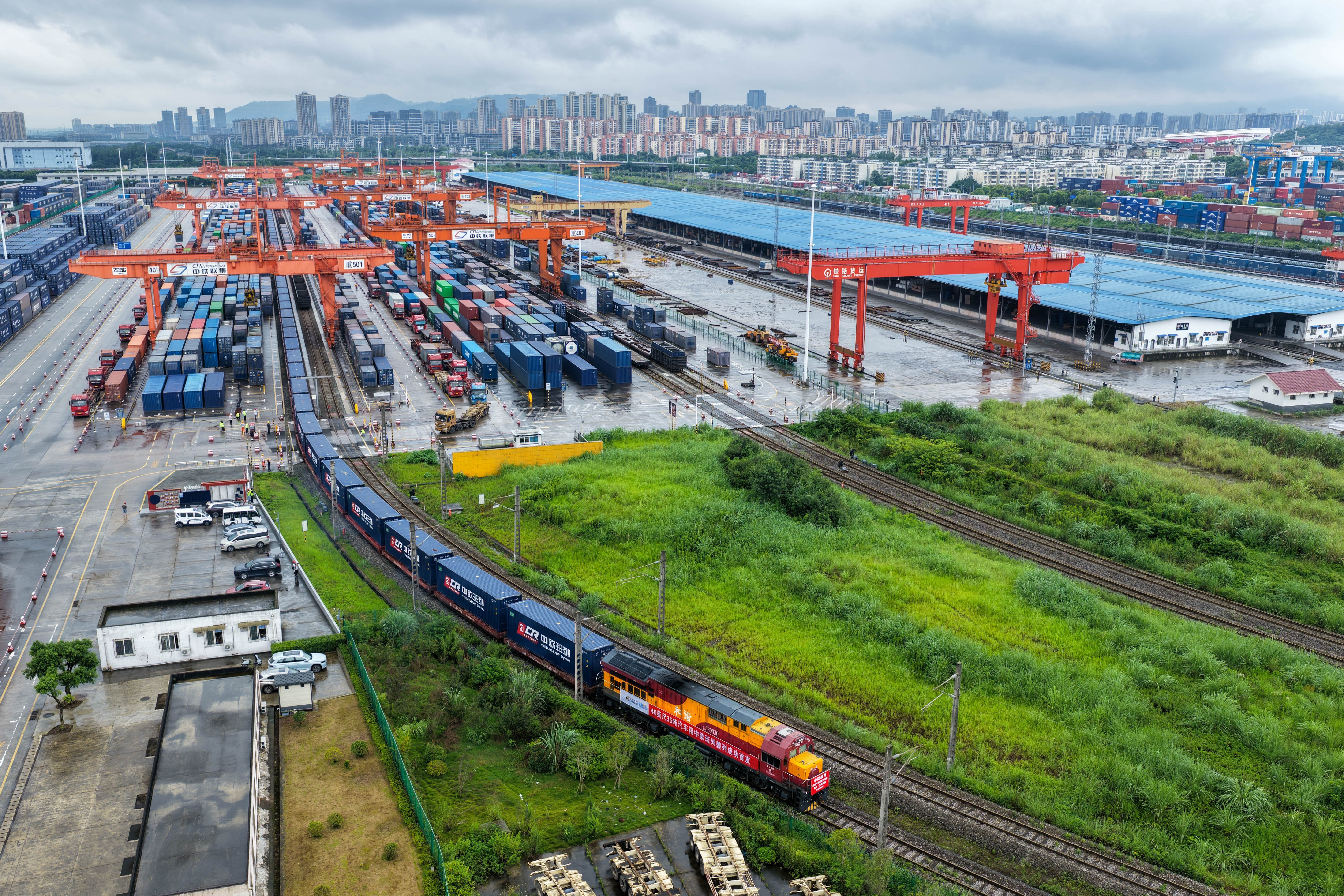
The China-Europe freight train service has become an important bridge for closer international economic and trade exchanges, connecting production and consumption between the two regions and promoting commodity circulation and industrial complementation among the countries along the routes.
Liang Linchong, director-general of the department of regional opening-up at the National Development and Reform Commission of China, said this at a recent press conference. A flagship project of the Belt and Road Initiative, the China-Europe freight trains have completed more than 130,000 journeys to date, transporting goods worth over 520 billion USD in total.
The annual trips made by these trains surged from 1,702 in 2016 to 20,022 in 2025, with an average growth rate of 30 percent year on year. They have transported more than 50,000 kinds of products in 53 categories, and the proportion of the goods' value in the total value of China-Europe trade in goods is increasing annually.
Liang said over the past decade, China has signed nine bilateral and multilateral intergovernmental cooperation agreements with countries along the China-Europe freight train routes, and hosted two China Railway Express Cooperation Forums, resulting in 159 practical cooperation outcomes.
An important platform for deepening connectivity across Eurasia, this freight train service has also improved the infrastructure network along the routes. It now operates on 96 routes, forming a diversified overseas corridor network reaching 236 cities in 26 European countries. The efficient and multi-directional transport network integrates both land and sea links.
A case in point is the Trans-Caspian International Transport Route, an important route for the southern corridor of the China-Europe freight train service. Countries along this route are jointly expanding and upgrading infrastructure, including ports, railways, border crossings and logistics terminals, and addressing bottlenecks and constraints to boost transport volumes.
In the first half of 2026, the freight volume of China-Europe freight trains along the southern corridor increased by more than 90 percent year on year.
The China-Europe freight train service provides new opportunities for inland regions to pursue opening-up and development. It has fostered the growth of border port and hub economies, and helped countries and regions along the routes better integrate into the open world economy, Liang added.
Thanks to it, Malaszewicze, a small border town in Poland, has become a key logistics distribution center of the European Union. German city Duisburg has transformed itself from a traditional industrial city to a crucial European logistics hub.
Looking ahead to the 15th Five-Year Plan period (2026-2030), China will improve transport organization services. Liang said coordination across the China-Europe freight train network will be strengthened, transport organization models optimized, and customs clearance facilitation enhanced. The stability and reliability of end-to-end transit times will be improved.
The corridor network will be improved by coordinating different modes of transport, including rail, road, maritime and air transport, and developing new multi-modal transport routes. Furthermore, intergovernmental cooperation mechanisms will be strengthened to enhance coordination with countries along the routes and ensure secure and smooth operation.
In addition, China will further advance the digital, intelligent and green development of the freight train service, enhance collaborative innovation capabilities, accelerate the application of new technologies and equipment, and foster new drivers of growth.