
Air-ground System Keeps Spraying Drones Flying Longer
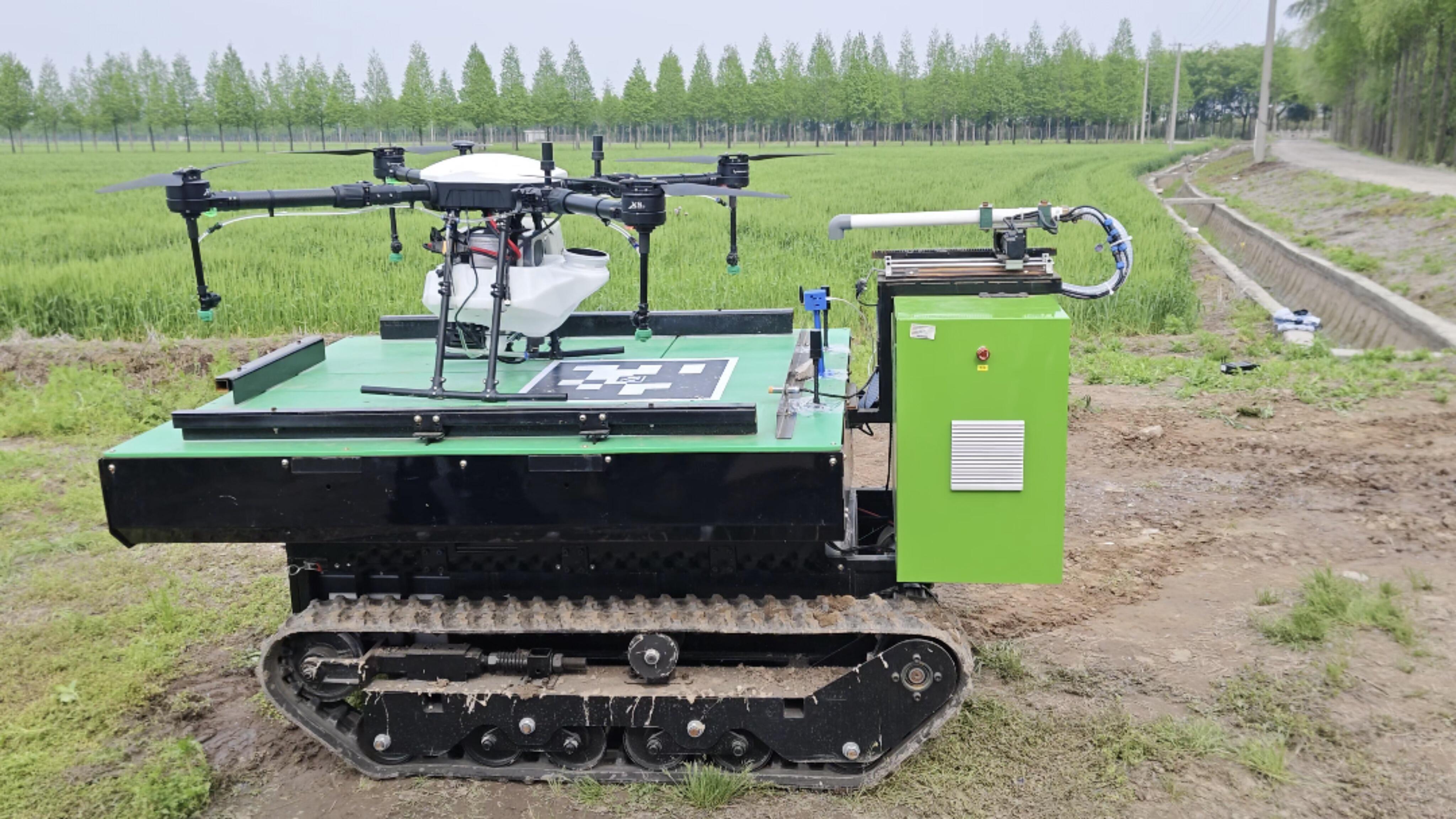
A research team led by Professor Ding Shihong of the School of Electrical and Information Engineering at Jiangsu University in east China has successfully completed key functional tests of an "air-ground collaborative autonomous liquid-refilling platform." The system enables drones to land with pinpoint precision and automatically refill pesticides, executing the entire process without human intervention.
For agricultural drone operators working in large fields or hilly areas, the biggest headache is often not pests or diseases, but the limited payload capacity of the drones. A single drone typically has to return for refilling less than 10 minutes after takeoff. Each round trip can take more than 10 minutes. When three to five drones operate simultaneously, operators can find themselves overwhelmed.
This system consists of two spraying drones, a refilling unmanned ground vehicle, and a unified intelligent ground station — simply put, the drones are only responsible for flying, while the unmanned vehicle handles the "liquid delivery."
The concept is straightforward: while the drone carries out spraying from the air, the unmanned vehicle waits at a designated location along farm roads. When the pesticide supply runs low, the system automatically calculates the optimal landing point. The drone then flies to the vehicle, lands precisely, and refills automatically before resuming operations — eliminating the need to return to a fixed base.
To accelerate the transition from laboratory research to real-world agricultural applications, the team moved its testing center directly to farmland. However, the complex wind conditions in hilly areas created significant challenges. The drones would sometimes drift during flight, deviating from planned routes.
To address the problem, the team applied a self-developed generalized super-twisting sliding mode control algorithm for path tracking. This significantly improved the drones' resistance to external disturbances. Field tests showed that the drone's straight-line tracking error could be controlled within ±10 centimeters, while the unmanned vehicle maintained a straight-line path tracking accuracy within ±5 centimeters.
Field trials demonstrated that the optimal operation paths automatically planned by the upper-level control system eliminated the need for highly experienced drone operators. Daily operation costs could be reduced by around 200 RMB, while route repetition rates dropped from 10–15 percent to below five percent under skilled manual operation.
The time required for a single drone liquid refill was shortened from five minutes to less than two minutes, doubling effective operating time. A single liquid-refilling unmanned vehicle can simultaneously support two spraying drones, enabling operators to complete an entire operation cycle without having to manually refill pesticides.