

Decoding 'Spectral Fingerprints' of Yungang Grottoes
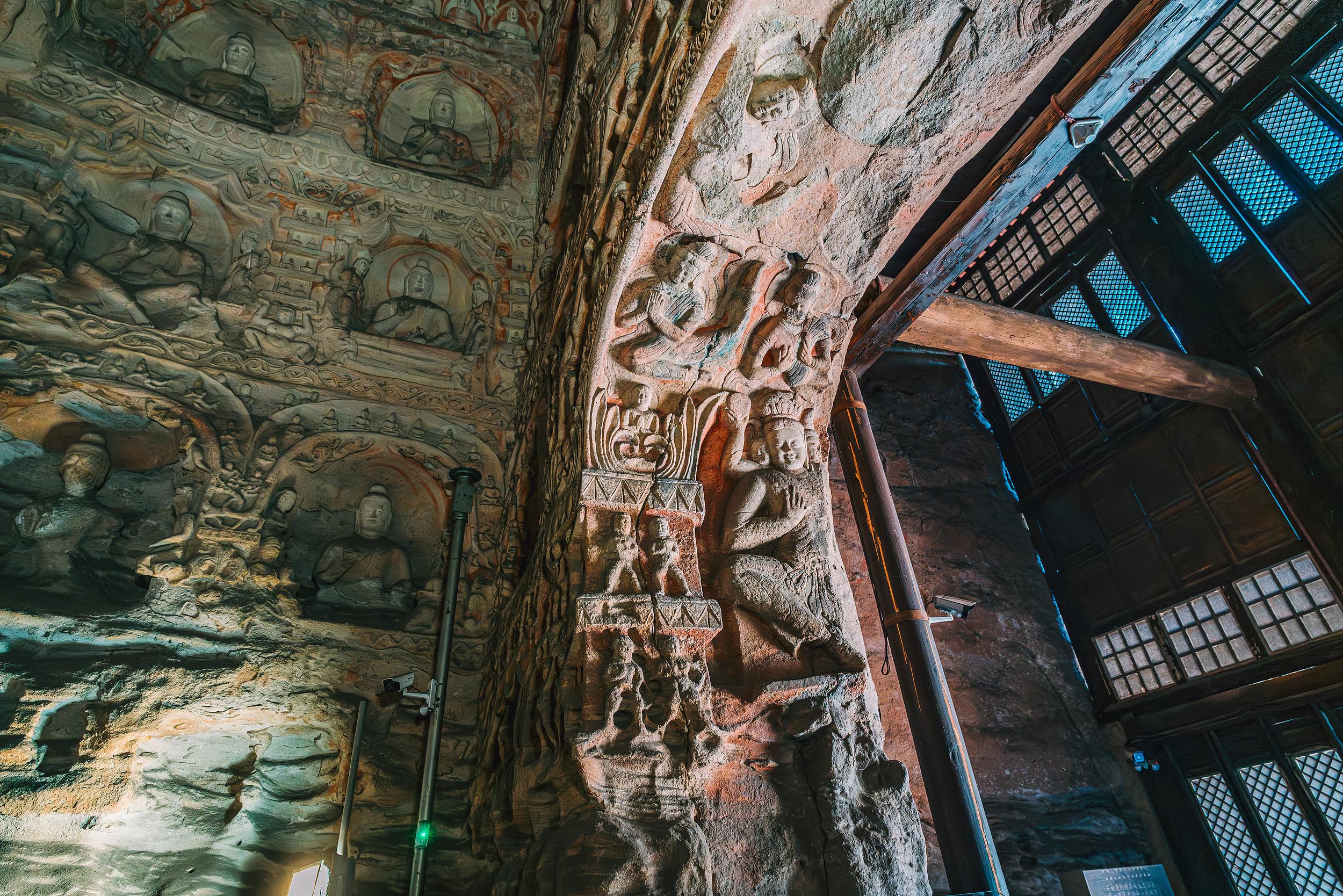
The newly released World Internet Conference Cultural Heritage Digitalization Case Collection (2026) presents the latest global achievements in digital heritage preservation, featuring 45 outstanding practices from 13 countries and regions. Among the highlighted projects is an innovative initiative that applies 3D hyperspectral data acquisition to Caves 7 and 8 of China's Yungang Grottoes. Marking a global first, the project systematically deploys hyperspectral technology for the digital conservation of large-scale three-dimensional stone relics, opening a new chapter in fine-grained grotto documentation.
Listed as a UNESCO World Heritage Site in 2001, Yungang Grottoes preserves 45 major cave complexes. The site launched its digital preservation program in 2003, yet early efforts relied merely on two-dimensional geometric recording, failing to deliver complete, accurate and detailed data for its complex 3D cave structures. Limited by conventional scanning tools, researchers long struggled with blurred observations, measurement inaccuracies and incomplete relic records.
Hyperspectral imaging has emerged as a game-changing solution, integrating high-precision spectral and spatial resolution to analyze rock compositions and capture invisible subsurface and surface relic information unrecognizable to the naked eye. Despite years of technical development, the technology had never been fully applied to large grotto sites before the Yungang project.
A collaborative team led by the Yungang Research Institute, together with the Sun Yat-sen University and a professional technology firm, developed customized acquisition equipment and a full-process technical system covering data collection, correction, fusion and analysis. Centered on constant-temperature, broad-spectrum, low-heat light-source data acquisition equipment, the new framework eliminates disturbances from temperature fluctuations and unstable lighting, acquiring stable, long-term and large-area data on fragile cave surfaces.
Its pioneering 3D and hyperspectral fusion technology achieves high-precision alignment of geometric shapes, surface textures and spectral information. The world's first 3D hyperspectral data fusion analysis and visualization platform enables the deep integration and unified display of 3D models and hyperspectral data, as well as the three-dimensional spatial visualization of pigment composition and disease distribution.
In 2025, the team completed full data collection for Caves 7 and 8, Yungang's earliest twin caves featuring a blend of Greek, Gandhara and traditional Chinese architectural styles. Through optimized lighting designs, precise temperature control and multi-angle data supplementation, the team avoided thermal damage and scanning blind spots, adopting non-intrusive, low-impact operations to protect fragile relics.
The five-month field campaign harvested 29.2 terabytes of high-quality data across 1,465 square meters, recording millimeter-level 3D geometry and unique "spectral fingerprints" for stone and pigment remains.
While visitors to the Grottoes can observe only rough surface contours, the new digital model enables in-depth analysis including rotary viewing, sectional observation and shadow area restoration. It precisely identifies mineral components, salt stains, water erosion, early deterioration, residual pigments and historical restoration traces through exclusive spectral features.
Building on the findings, the Yungang Research Institute is constructing dedicated databases for cave spectra, pigment colors and relic diseases. By integrating hyperspectral results with 3D laser point cloud data, researchers support intelligent pigment analysis and disease identification, providing systematic data support for scientific grotto conservation.
The institute has also launched a digital preservation project covering Caves 38 to 45 and affiliated caves. By expanding 3D hyperspectral scanning, it aims to build a complete holographic digital archive, securing the millennia-old Yungang Grottoes for permanent digital inheritance.