
Minhe: From Black Industrial Corridor to Green Benchmark
The year 2026 marks the 40th anniversary of the Minhe Hui and Tu autonomous county under the administration of Haidong city, Qinghai province in northwest China. From scattered small workshops to the targeted development of a 10-billion-RMB characteristic industrial cluster, Minhe has completed a remarkable transformation from extensive growth to chain-based industrial development, emerging as a regional benchmark for green transition.
Ferrosilicon is a core alloy used in metallurgy and casting, significantly boosting steel's strength, hardness and elasticity. After the county's first ferrosilicon enterprise became successful, private ferrosilicon manufacturers mushroomed.
However, this extensive development took a heavy toll on the local ecology, and Minhe became the polluted "Black Ferrosilicon Corridor."
In 2007, to address this, the county phased out backward production capacities and built an industrial park. The Beishan Ferroalloy Factory was the first to relocate to the park and upgrade its production process, restructuring into the Minhe Yunfeng Welfare Ferroalloy Factory.
Ferroalloy production is a traditional high energy-consuming sector, with electricity costs accounting for over half of total manufacturing expenses. In October 2025, a waste heat power station built by the Yunfeng factory with an investment of 58.4 million RMB was connected to the grid, boasting an annual power generation capacity of 43.2 million kWh. The project has blazed an innovative green path of turning waste into resources for traditional energy-intensive industries.
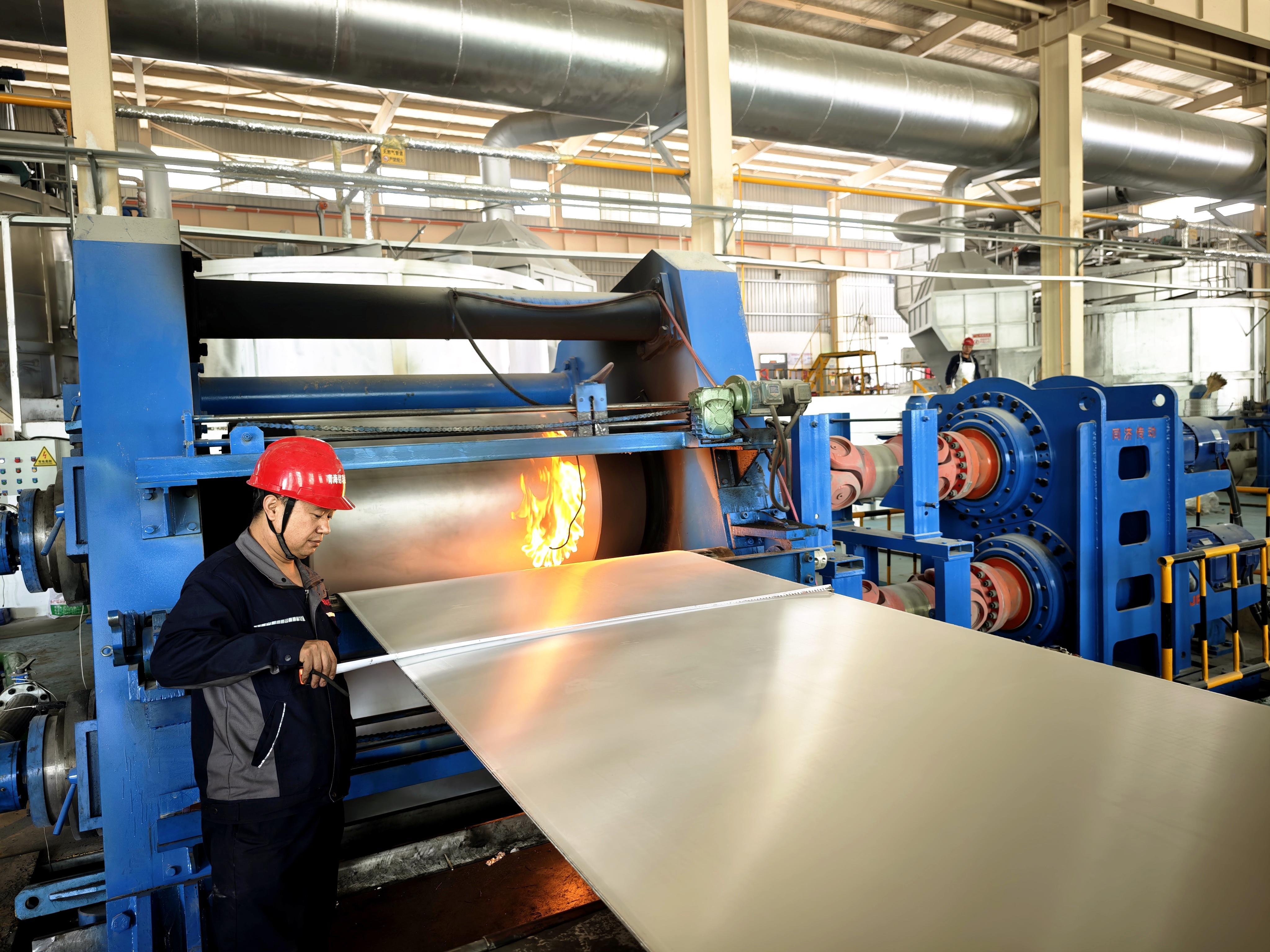
Today, the industrial park is dominated by ferroalloy smelting, aluminum smelting and deep processing, and lithium-ion battery anode material production, evolving into the core engine of the county's economy.
The once smoke-choked"Black Ferrosilicon Corridor"has been transformed into a"Peach Blossom Corridor."
In 2018, Minhe began constructing a suburban park, Shina Park, on the site of a former magnesium plant, integrating ecological restoration, natural science popularization and space for riverside leisure.
Zhang Beibei, an engineer with the Landscape Center of Minhe Forestry and Grassland Bureau, said the county has invested 172 million RMB to renovate the former plant and surroundings and improve the environment of the Huangshui River basin. The work includes demolishing over a hundred obsolete factory buildings, paving 64,500 square meters of hardened roads, and full-scale soil covering and greening.
Over 13,200 trees of various species have been planted, with peach trees making up more than 60 percent, according to Zhang.
Shina Park epitomizes a decade of ecological progress in Minhe. Over the past 10 years, the county has completed greening of more than 1.24 million mu (1 mu ≈ 0.0667 hectares), advancing large-scale afforestation, barren mountain and slope rehabilitation, and ecological corridor construction.
Official data shows Minhe's forest coverage rate jumped from less than 10 percent a decade ago to 30.18 percent at present, reversing its previous predicament of scarce forest resources and fragile ecology.
Breaking away from the old high-energy, extensive industrial development track, Minhe has embarked on a new path of high-quality development featuring industrial upgrading, ecological improvement and industrial chain agglomeration.