

BRICS STI Partnership Yields Fruitful Results
Through joint scientific expeditions, collaborative disaster relief, partnerships in mega-science projects, and cross-border transformation of sci-tech achievements, cooperation in science, technology, and innovation (STI) is continuously taking root and bearing fruit across BRICS nations.
Exploring the deep blue
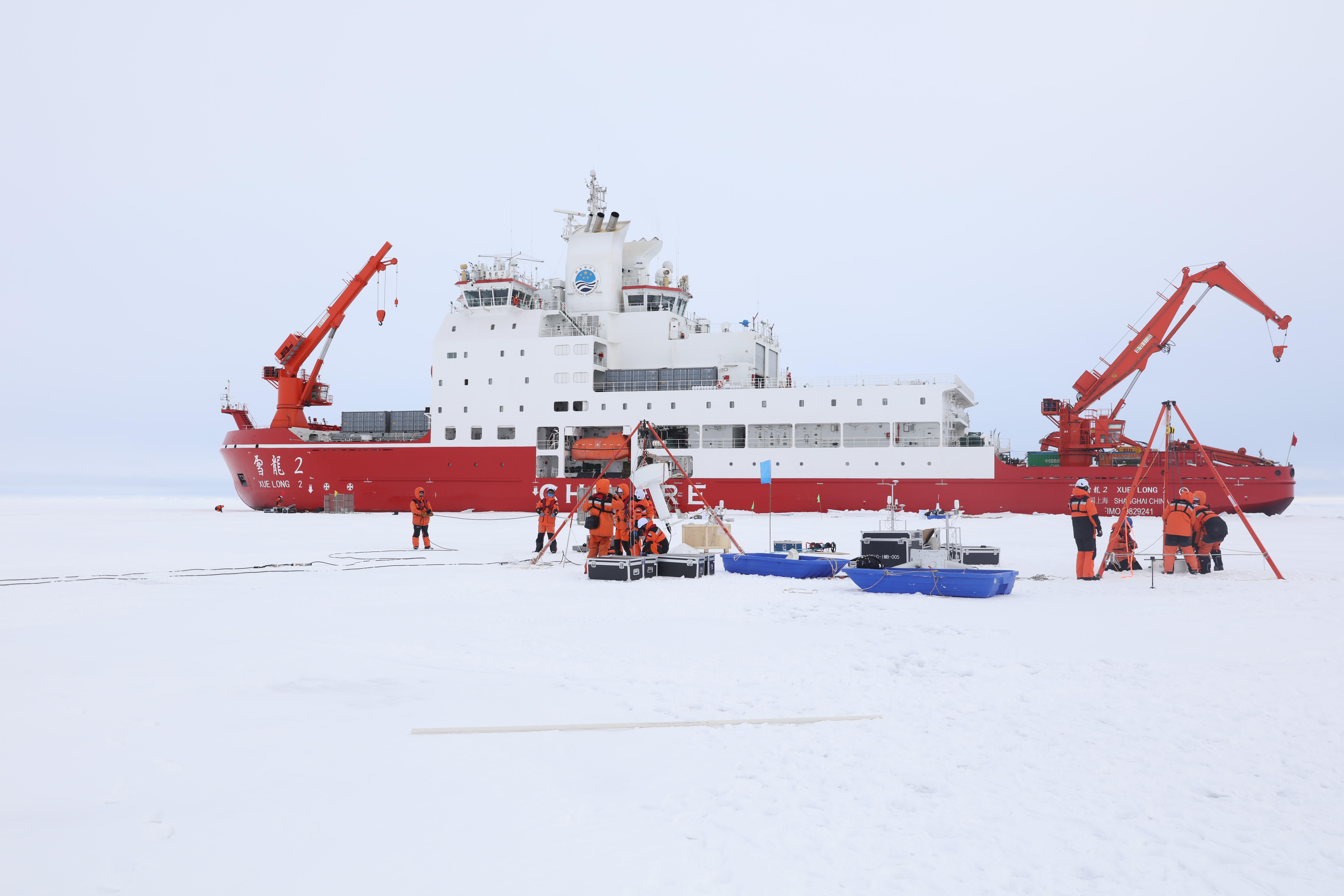
This March, Indian scientist Shramik Maruti Patil boarded the research vessel Xuelong 2 to conduct a joint scientific expedition on the "Autumn Southern Ocean Ecosystem."
"The Xuelong 2 provided me with a valuable opportunity to exchange ideas with scientists from diverse research backgrounds," Patil said. His trip to Antarctica was made possible by an invitation from the BRICS Deep-Sea Resources International Research Center.
"We are advancing deep-sea research cooperation through joint scientific expeditions, co-construction of platforms, exchange and training programs," said Tao Chunhui, director of the Center.
Chen Qizhen, deputy director-general of the Administrative Center for China's Agenda 21, said, "As the center's administrative office, we will further play a coordinating role. Our goal is to build a collaborative platform for joint research and resource sharing for BRICS researchers, ultimately driving more practical cooperative outcomes."
Empowering rescue efforts
Last year, triggered by heavy rainfall, landslides struck Central Java province and floods hit Sumatra Island in Indonesia, causing severe damage and losses.
Indonesia requested emergency disaster relief support from China, and the Land Satellite Remote Sensing Application Center under China's Ministry of Natural Resources swiftly formulated satellite imaging plans for the affected areas, acquired local satellite imagery, and built a dedicated online service page to deliver real-time data.
"These activities supported emergency disaster relief efforts, and will be used to strengthen future related research," said Rokhis Khomarudin, head of the Research Center for Geoinformatics at Indonesia's National Research and Innovation Agency.
"China's land remote sensing satellite data has played an important role across multiple BRICS nations, supporting emergency disaster response, foundational surveying and mapping, resource management, and ecological protection," according to Tian Haibo, director-general of the Land Satellite Remote Sensing Application Center.
Facilitating R&D
Since 2024, the Institute of Plasma Physics under the Chinese Academy of Sciences (CAS) has been organizing annual activities, including fusion training courses for young scientists, student summer camps, and summer research programs. To date, over 100 students from BRICS countries have participated in them.
Leveraging mega-science facilities, scientific research cooperation and personnel exchanges among BRICS nations continue to deepen.
Eduardo Granado, physics professor at Brazil's University of Campinas, is currently researching a new type of magnetic material.
In March, he visited the China Spallation Neutron Source (CSNS). Utilizing its Multi-physics Instrument under low-temperature conditions, he successfully detected the magnetic peaks of the material samples, providing crucial experimental evidence to unveil their microscopic magnetic structures.
To date, the CSNS has assisted 10 universities and research institutions from BRICS nations in completing over 100 experiments.
"Advanced neutron sources have been listed as a priority area for sci-tech cooperation among BRICS nations. The CSNS will continue to expand its open sharing, providing platform support for sci-tech cooperation among BRICS countries," said Li Xiao, deputy director of CSNS at the Institute of High Energy Physics, CAS.
Improving people's livelihoods
At the China-BRICS Science and Innovation Incubation Park for the New Era, headquartered in Xiamen, a company co-founded by scientists from China, India, and Russia has successfully tackled bottlenecks to develop an aquaponics recirculating aquaculture solution.
"Currently, Indonesian enterprises have clearly expressed their investment intentions for this technology," said Cao Weimin, deputy director-general of Xiamen Municipal Bureau of Science and Technology. This technology is expected to provide a new option for BRICS nations' fisheries to resolve the contradiction between environmental protection and industrial development.
As a collaborative research initiative, BRICS-Bioenergy from Eco-Sustainable Technology has evolved into an industry-university-research collaborative innovation platform spanning multiple countries.
At Tianjin University of Science and Technology, scientists from countries including China and South Africa are conducting joint research to tackle key technologies for next-generation biorefining, specifically targeting sugar industry by-products such as sugarcane bagasse and molasses.
"Together with our partners, we have stepped onto the front lines of production to learn, research, and exchange ideas within real production scenarios," said Wang Zhengxiang, a professor at Tianjin University of Science and Technology. "We aim to transform sugarcane, a major agricultural resource, into green wealth for BRICS nations."
Data shows that BRICS nations publish over two million scientific papers annually. How to better facilitate the cross-border transformation of these sci-tech achievements from the "bookshelf" to the "market shelf" is exactly what the BRICS Technology Transfer Center has been promoting.
"The true success of scientific research achievements lies in taking root, and the key to the cross-border transformation of sci-tech achievements lies in mutual recognition of standards and the training of technology managers," said Li Muqian, a research fellow at the center.
Li believes that BRICS nations should establish a mutually recognized, practical, and applicable system for technical standards and technology managers based on their actual conditions, serving the flow of technology and common development among member states.