
Satellite Remote Sensing Empowers China-Africa Cooperation
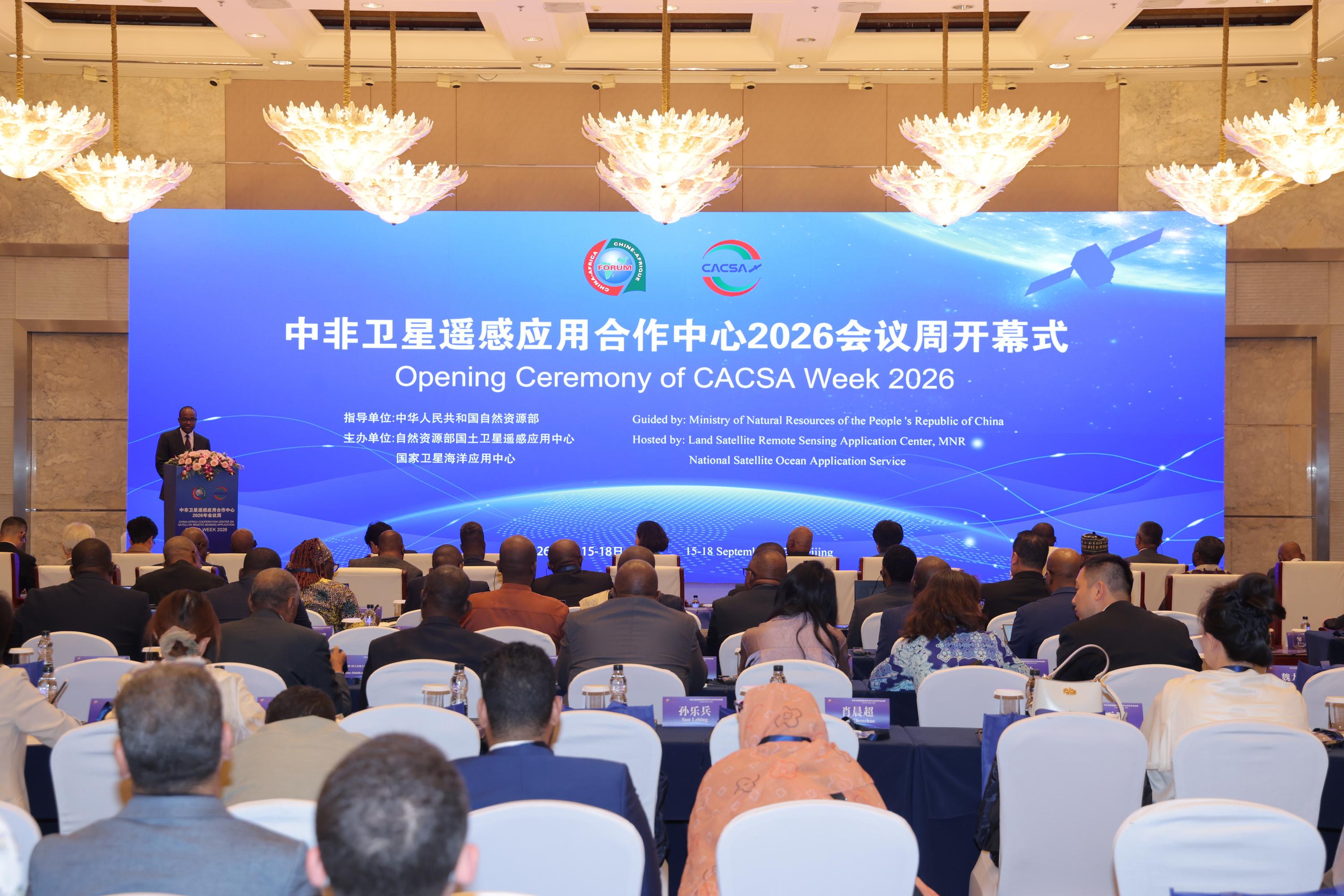
Themed "Intelligent Earth Observation Empowering China-Africa, Win-Win Cooperation Forging a New Chapter," the China-Africa Cooperation Center on Satellite Remote Sensing Application (CACSA) Week 2026 was held in Beijing from September 15 to 18.
Zhou Xing, vice minister of natural resources, said that since its establishment four years ago, CACSA has always been rooted in Africa's development realities, consolidating the foundation for cooperation through data sharing, overcoming development bottlenecks through technological empowerment, and stimulating endogenous momentum through talent cultivation. It has advanced the development of cooperation mechanisms and promoted the alignment of China's satellite remote sensing application technologies with Africa's sustainable development needs.
In data sharing, statistics show that to date, CACSA has signed cooperation memorandums with the government departments of 20 African countries and the Regional Centre for Mapping of Resources for Development.
It has established 16 natural resources satellite remote sensing cloud service platform nodes, providing free access to African partners more than 90,000 scenes of high-resolution remote sensing images, covering fields such as land surveys, forest monitoring, and disaster prevention and mitigation.
CACSA has also attached great importance to the sharing and dissemination of knowledge and technology, and has strengthened the provision of public goods in the field of satellite remote sensing applications.
It provided African partners, free of charge, with a series of remote sensing AI large models, software solutions, and thematic atlases. These efforts promote the use of satellite technologies by African countries in fields such as cultivated land protection and ecological governance, thereby benefiting local people's livelihoods and well-being.
In talent cultivation, the center has carried out training on satellite data processing and applications through various means, reaching about 500 person-times of professionals from African countries. In addition, it has jointly trained more than 10 African doctoral and master's students with universities.
Gaspard Twagirayezu, chief executive officer of the Rwanda Space Agency, said that satellite remote sensing is more than a technology advancement; it is also a critical enabler of sustainable development for Africa. CACSA has been instrumental in providing useful satellite data and offering capacity-building opportunities, and Rwanda Space Agency has been using Chinese satellite data, especially in disaster management. "I'm certain that this cooperation will contribute immensely to enhancing our country's decision-making, efficient resources management, and the overall resilience."
Citing applications of images from the natural resources satellite remote sensing cloud service platform node in Nigeria as an example, Godstime James, director of the Strategic Space Applications Department at Nigeria's National Space Research and Development Agency, said that the story is no longer only about receiving imagery, but also about converting imagery into national use cases. "China–Nigeria Earth Observation collaboration becomes most valuable when imagery is translated into repeatable applications for public decisions."
The CACSA Week 2026 was jointly hosted by the Land Satellite Remote Sensing Application Center under the Ministry of Natural Resources and the National Satellite Ocean Application Center.