

All-Weather Aerostats: Long-Endurance Airborne Nodes
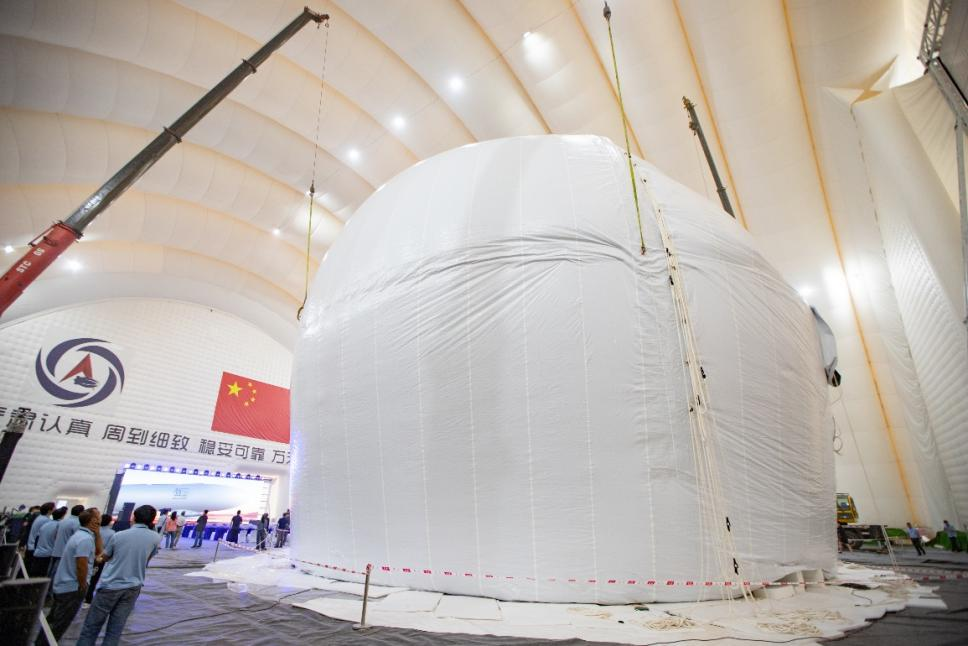
The launch ceremony for the world's first all-weather aerostat Yunshao M1000-CNS was held in Rong county, Sichuan province on September 22.
Beijing Yufeng Flight Technology Co., Ltd. officially unveiled this "aerial tower," which features an integrated communication, navigation, surveillance, and meteorology system capable of continuous airborne operation for up to five years. This marks the transition of low-altitude airborne networks from single-point validation to systematic deployment.
The Yunshao M1000-CNS measures 21 meters in diameter and 24 meters in length. Operating at kilometer-level altitudes, the platform boasts a mission payload capacity of over 300 kilograms. To withstand extreme environments, it utilizes a rigid-flexible coupled structure and integrates wind power, photovoltaics, and energy storage systems. This setup allows the platform to operate seamlessly day and night across changing seasons, completely weatherproofed against harsh elements like rain, wind, snow, and lightning. It is designed for a continuous airborne endurance of five years and a total service life of 20 years.
According to Shi Zhiguang, chairman and CEO of Beijing Yufeng Flight Technology Co., Ltd., the Yunshao M1000-CNS condenses a "five-in-one" capability framework—communication relay, navigation enhancement, wide-area surveillance, meteorological observation, and countermeasure sensing—into a rapidly deployable and modularly replicable airborne node.
"A single platform covers an area of approximately 2,000 square kilometers, and achieves a differential navigation enhancement accuracy down to the 20-centimeter level," Shi stated. Deploying long-endurance aerostats like the Yunshao to serve as "always-on aerial outposts" is the key to transforming the burgeoning low-altitude economy into a truly integrated, network-connected industry.
In the past, airships and tethered balloons were primarily relegated to tourism, mapping, meteorological sounding, or single-point mission support. Today, with the maturation of low-altitude airspace management, 5G-A integrated sensing and communication, BeiDou high-precision positioning, satellite internet, and AI scheduling capacities, aerostats have evolved from mere "floating vehicles" into long-endurance airborne nodes. As a result, they are rapidly emerging as one of the equipment categories with the most fundamental "infrastructure-base attributes" within the new low-altitude infrastructure ecosystem.