

'Big Windmill': World's Earliest Vertical-axis, Multi-sail Wind-powered Machine
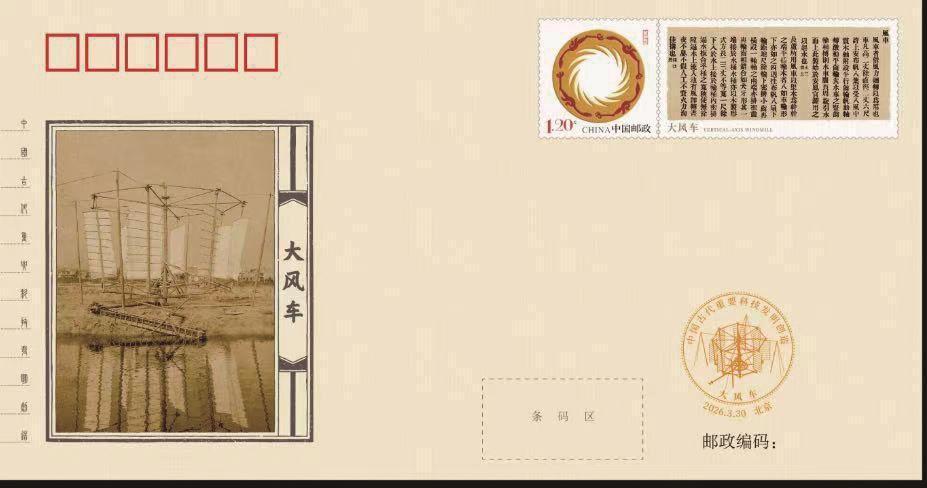
Over 2,000 years ago, horizontal-axis winnowing fans were being used in China to separate grain from chaff. These agricultural tools, operated by hand or foot, rotated fan blades to generate airflow and separate grain from husks. They are the world's earliest centrifugal grain-winnowing machines. Introduced in Europe in the 18th century, these fans revolutionized Western grain processing and laid the foundation for modern blowers.
The "Big Windmill" specifically refers to the practical, vertical-axis, sail-equipped windmill that emerged during the Southern Song Dynasty (1127-1279). Historical records indicate that it was used to drive waterwheels for irrigation. This indigenous Chinese invention predated European horizontal-axis windmills by centuries. Unlike the simple vertical-axis windmills of Persia or the horizontal-axis windmills of the Netherlands, this design employed a balanced Chinese junk-sail structure, making it a unique drag-type vertical-axis wind machine.
The windmill's main body consisted of an octagonal-prism frame made of solid wood with a central vertical drive shaft. Eight masts extended outward to suspend the sails, and the base of the main shaft was connected to a "dragon-bone" waterwheel via a gear mechanism (a type of chain pump).
The windmill's core innovation was its adaptive sail mechanism. The sails were mounted off-center and restrained by ropes. The sails on the downwind side automatically opened to face the wind perpendicularly, maximizing force capture. The sails on the upwind side automatically pivoted to align parallelly with the wind, minimizing drag. This enabled continuous rotation in the same direction, regardless of the wind's angle, without the need to rotate the entire machine, offering a significant advantage over the rotating-turret structures of European windmills.
Since ancient times, large windmills have primarily been used for farmland irrigation and drainage. Widely used in water-rich regions such as northern Jiangsu and the Jiangnan area, they allowed the continuous diversion of river water into rice paddies, eliminating the need for human or animal labor. During flood seasons, they quickly drained accumulated water from low-lying areas, freeing up significant agricultural manpower.
These windmills were also used to pump brine for sea salt production. Large-scale deployments were found in the Changlu and northern Jiangsu salt fields, where the windmills pumped saline groundwater for solar evaporation.
These windmills represent the world's earliest mature vertical-axis water-lifting windmills, capable of operating in winds from any direction. They integrated ancient shipbuilding, sail and gear mechanics technology, as well as hydraulic engineering. This combination of technologies embodies ingenious adaptation of engineering solutions to local conditions. Furthermore, their self-adjusting sail design offers a traditional technological reference for modern vertical-axis wind power generation equipment.