
Chinese Skills Power Indonesia's Green Transition
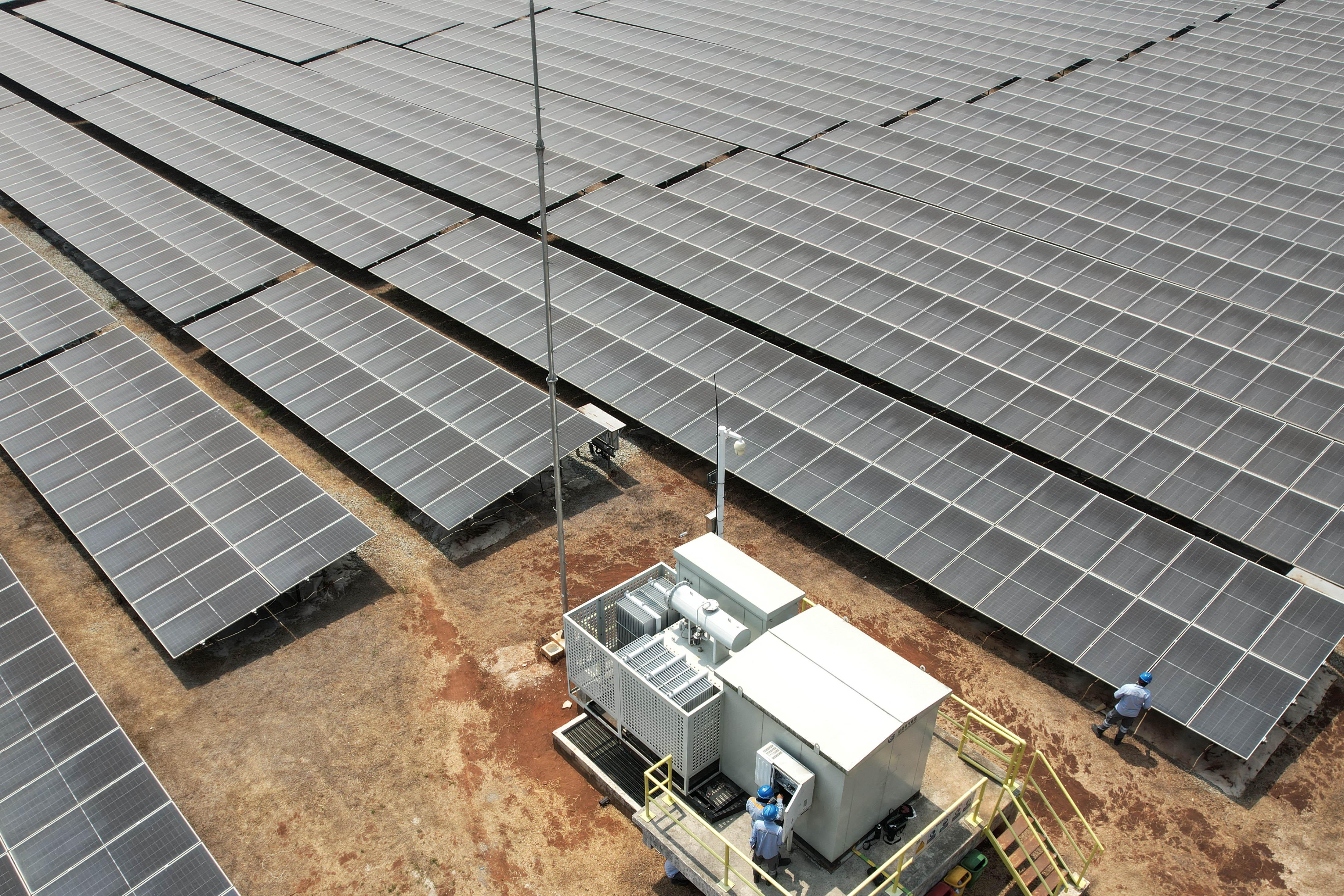
About one-hour drive southeast from Jakarta leads to the Karawang Industrial Park in Indonesia's West Java province. Through a stretch of trees, rows of gray photovoltaic (PV) panels spread across the terrain, glinting faintly in the sunlight. This is the Karawang 100 MW PV project, undertaken by PowerChina Hubei Engineering Co., Ltd. Here, sunlight is converted into electricity and transmitted to the industrial park, providing clean power to factories.
The project was connected to the grid in July 2024 and put into operation the following month. The clean electricity it supplies has cut annual carbon dioxide emissions by 19,800 tons, saving about 8,800 tons of standard coal.
The technical experience gained during construction has carried over into the daily work of local employees. "I didn't know much about this system before, but now I can operate it skillfully," said a local operator in the central control room.
Inverters, transformers, photovoltaic modules...each type of equipment has different operational requirements, which makes it necessary for technicians to continuously learn and accumulate experience. For the operator, this job not only puts his university education to use but also introduces him to new technologies.
He hopes the station's power generation will increase and Indonesia will introduce more advanced renewable energy technologies in the future.
The transfer of technology began as early as the project's construction. Yang Xiaopei, project manager of PowerChina Hubei, told reporters there were insufficient local construction resources for large-scale onshore PV projects. Previous onshore PV projects in Indonesia were generally small in scale, few local subcontractors had experience in large-scale project construction, and skilled PV mounting workers were particularly scarce.
To solve this problem, the project team arranged for Chinese technicians to train local workers, cultivating more than 300 skilled installation workers and maximum daily installation reaching 2.5 MW. From on-site demonstrations to hands-on operation, Chinese technicians integrated construction experience into practical work, enabling local workers to participate in large-scale PV project construction and ensuring the project proceeded smoothly.
Besides green electricity, project construction and operation also generate employment for local workers.
During peak construction time, the project employed about 800 to 1,000 workers. After completion, the on-site workforce decreased but daily operation, equipment overhaul, and maintenance of the station still require local employees, creating an opportunity for them to work in the new energy sector.
An Indonesian safety supervisor who once worked with Chinese technicians said although they sometimes needed translators to communicate, Chinese employees and managers were willing to share their experience and help local employees improve their skills.
Developing solar energy helps reduce dependence on traditional energy sources such as coal. He hopes Indonesia will build similar projects in the future to better utilize its abundant solar resources.
Beyond green electricity, technical exchanges and talent cultivation are also outcomes of the project. Through technical cooperation, Chinese enterprises help local employees improve their skills, adding momentum to Indonesia's clean energy development and green transition.