

ACS Nano: Connecting Global Nanoscience Community Through Trusted Science
A nanometer is one-billionth of a meter. At this scale, matter can exhibit distinctive optical, electrical, mechanical and biological properties, opening pathways to advances in microelectronics, precision medicine, clean energy, and quantum technologies. Nanoscience focuses on the very small, but addresses some of humanity's biggest challenges, including health, climate change, and sustainable development.
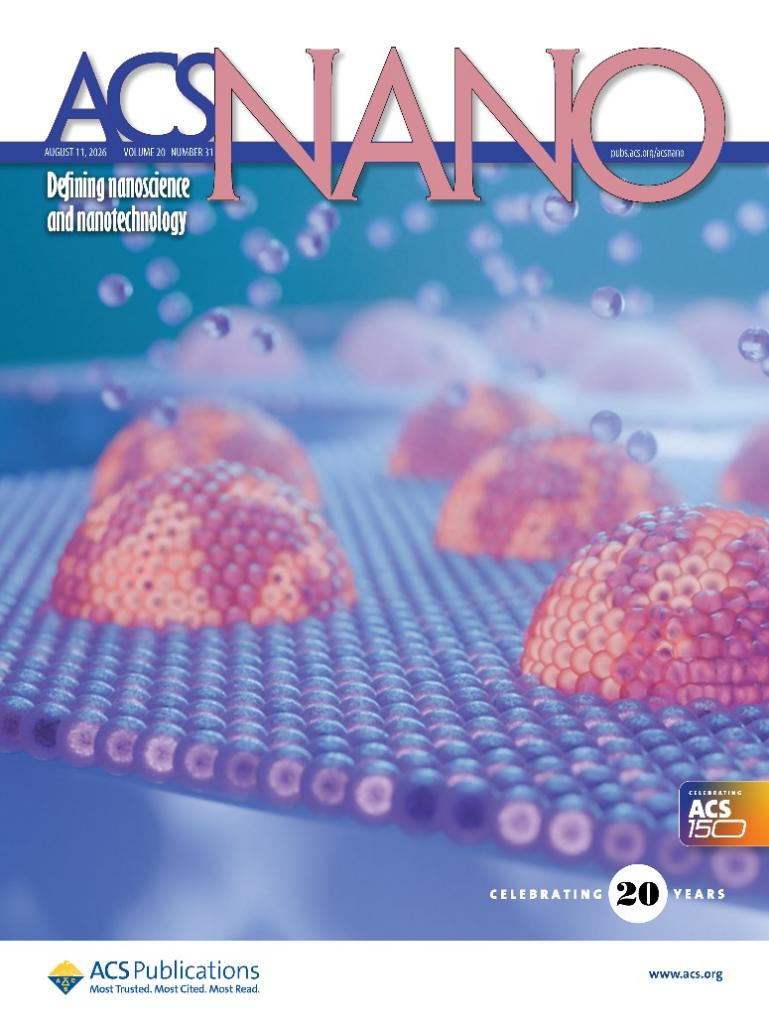
As editor-in-chief of ACS Nano, I have become increasingly convinced that the mission of an influential journal extends beyond publishing the latest discoveries. It must also help the scientific community determine which questions are worth pursuing, which evidence can be trusted, and where science should go next.
Trust, the foundation for connecting disciplines
ACS Nano was launched in 2007, when nanotechnology was advancing rapidly but research remained scattered across journals in chemistry, physics, materials science, biology, medicine and engineering. Consequently, studies often struggled to present their methods, evidence, and broader scientific significance in an integrated manner. From the outset, the journal has therefore emphasized complete and in-depth studies that can withstand peer scrutiny and move the field forward.
The cover of the inaugural issue featured the words "Defining nanoscience and nanotechnology." "Defining" did not mean setting boundaries around a field that was still evolving. It meant establishing a common language through which different disciplines could share questions, methods and standards.
After becoming the editor-in-chief in 2022, I summarized the journal's value in terms of creating three profound impacts in academic, education and nanoscience community building. These are advancing important scientific discoveries, helping young researchers develop sound judgment, and translating scientific knowledge into lasting public value. All three depend on trust.
Frontiers emerge through connection and participation
More than a decade ago, neuroscientists sought to observe more clearly how neurons connect, function, and communicate, but they lacked sufficiently precise tools for measurement and intervention. ACS Nano brought together researchers in nanoscience, neuroscience, imaging, and engineering to develop a technology roadmap. Together, they identified what existing tools could accomplish, where critical gaps remained, and which challenges required interdisciplinary collaboration.
This collaborative approach to identifying scientific frontiers has since been extended to other interdisciplinary fields. In 2025, we invited researchers worldwide to propose "33 Unresolved Questions in Nanoscience and Nanotechnology," bringing fundamental understanding, technological tools, real-world needs, and societal impact into a shared framework for discussion.
A list of questions does not offer standard answers; it provides a map of the unknown. A journal that brings dispersed knowledge and people together around important questions can help shape the frontier of the future.
Innovation creates value through system-level collaboration
Nanotechnology is undergoing a fundamental transition: from studying individual materials and devices to designing complex, interconnected systems, and from pursuing peak laboratory performance to ensuring reliability, safety, and sustainability in real-world settings.
A flexible sensor worn on the skin, for example, involves not only materials science and electronics but also medicine, data science, privacy and ethics. Individual performance metrics are only the starting point. Whether a device can be manufactured reliably, function consistently in real-world conditions, and avoid health or environmental risks are equally important scientific questions. Only by incorporating these considerations into the design process can innovation truly serve society.
In 2027, ACS Nano will celebrate its 20th anniversary. I hope it will serve not only as a platform for publishing research but also as a shared space where scholars exchange ideas, engage in dialogue, and forge collaborations across disciplines and borders.
The author is the editor-in-chief of ACS Nano, and a distinguished university professor at the Nanyang Technological University, Singapore.
●Journal Review
ACS Nano was founded at a pivotal moment in the rapid development of nanoscience and has remained an important chronicler in the field. It has published numerous pioneering studies that have profoundly influenced the development of nanomaterials, nanomedicine, energy, electronics and related fields. It has also helped shape the global scientific community's understanding of the future directions of nanoscience.
As a highly interdisciplinary field, nanoscience depends on the deep integration of knowledge, methods, and ways of thinking from different disciplines. ACS Nano values research that is complete, verifiable, and capable of supporting further advances. Through technology roadmaps and lists of major unresolved questions, it connects researchers across disciplines, countries and generations. In doing so, it demonstrates how an academic journal can move beyond recording research outcomes to helping build a scientific community.
I hope the journal will continue to preserve space for curiosity-driven, open-ended exploration while bringing researchers together around mission-oriented studies addressing human health and sustainable development.
—— Yu Jihong, an academician of the Chinese Academy of Sciences, and president of Beijing Normal University