

China’s Breakthrough in Propylene Production
By YIN Wei & CHEN Xi
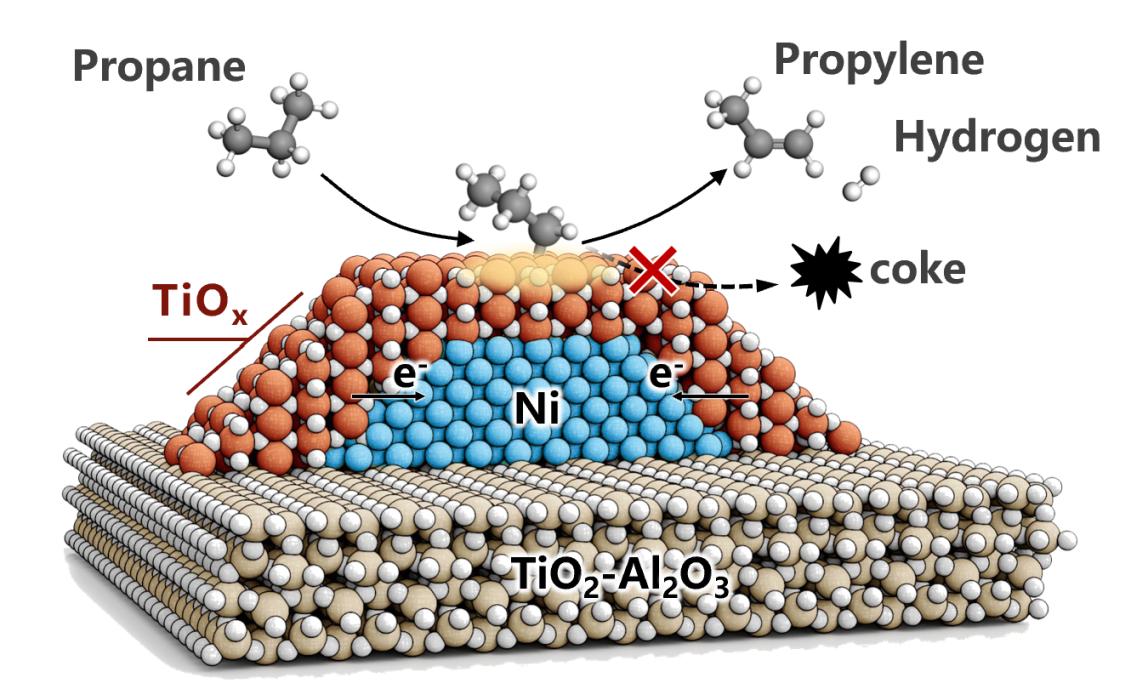
Defective TiOx overlayers catalyze propane dehydrogenation promoted by base metals. (COURTESY PHOTO)
Scientists from Tianjin University in China have developed a cost-effective and environment-friendly catalyst for the production of propylene, one of the highest produced basic chemicals globally, used to manufacture plastics, rubber, fibers, and pharmaceuticals.
The groundbreaking achievement boosts the development of sustainable catalysts for low-carbon olefin production technologies and is strategically important for the global petrochemical industry chains. In 2023, China's propylene production exceeded 60 million tons, accounting for approximately one-third of the global output, with its total value surpassing 600 billion RMB.
The finding is the cover story of the July 19th issue of Science.
Among the various propylene production technologies, propane dehydrogenation (PDH) is preferred due to its high economic efficiency and reduced dependence on petroleum. However, traditional PDH catalysts rely heavily on expensive platinum or the highly toxic chromium oxide, making the process costly and detrimental to the environment. The quest for a more efficient, cheaper, and greener next-generation propylene catalyst has thus become a global focal point in chemical research.
The Energy and Catalysis Adventure Team at Tianjin University hypothesized that inexpensive and environmentally friendly oxides could be used to interact electronically with metals, thereby enhancing the catalytic process. Based on this hypothesis, they developed a titanium oxide-nickel composite catalyst. Titanium is abundantly available, with China being one of the top source countries. Nickel is also plentiful globally.
The titanium oxide overlayers were tailored to completely coat an entire nickel nanoparticle through strong metal-support interaction at elevated temperatures under hydrogen reduction, which remained intact under propane dehydrogenation reaction conditions. The result was fine-tuned electronic transfer between titanium oxide and nickel, enhancing catalytic activity while suppressing side reactions such as cracking and carbon deposition.
This new catalyst demonstrates exceptional propylene selectivity and stability, outperforming international counterparts. It can reduce costs by 30-50 percent while ensuring non-toxic and low-energy consumption during preparation and use.
This innovation also provides feedback for the next generation of efficient, cost-effective, and sustainable propylene catalysts.