
Zhoubi Suanjing: Fundamentals of Astronomical Calculations
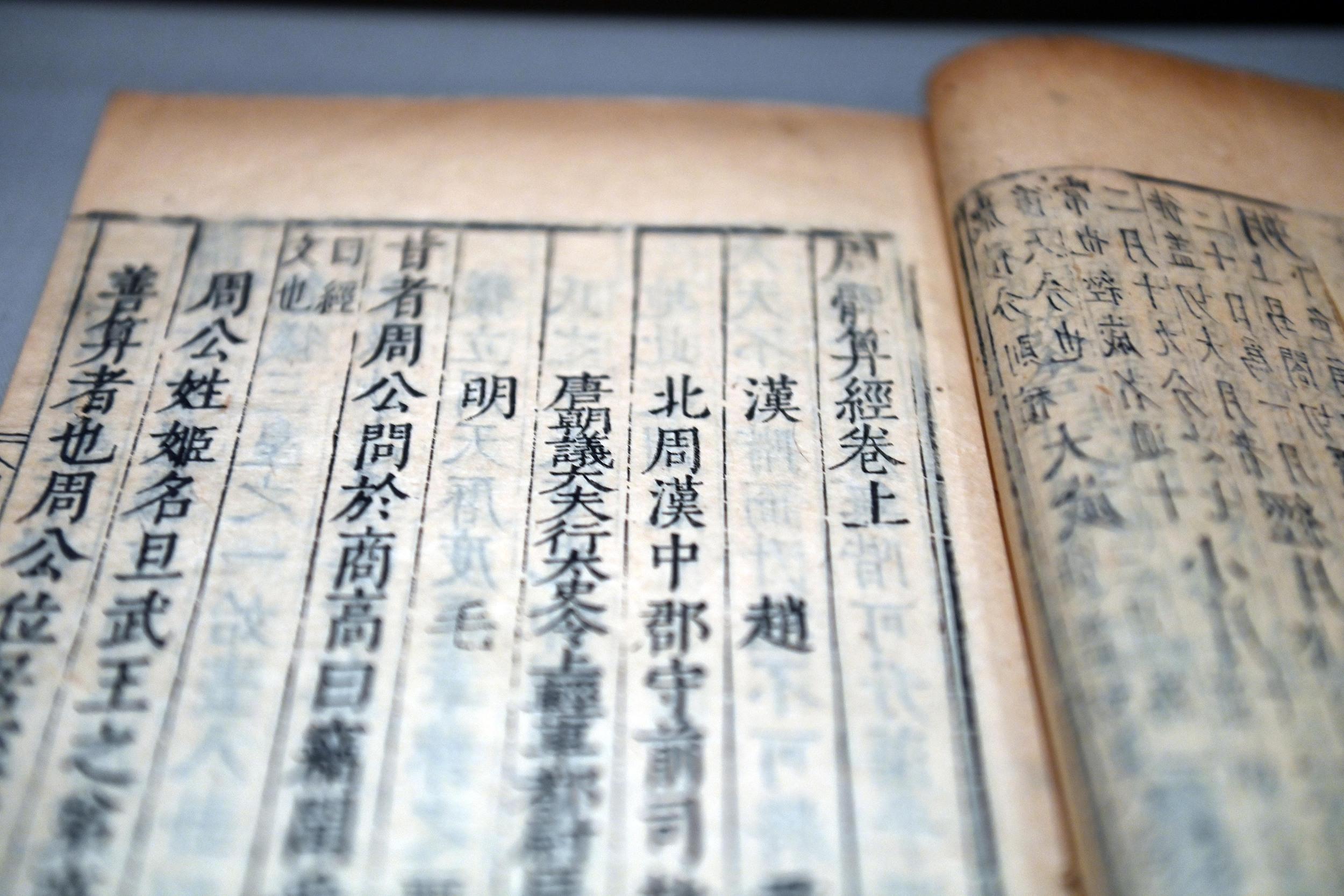
The Zhoubi Suanjing (The Mathematical Book on Gnomons and Circular Paths), written around the 1st century BC, is the oldest surviving Chinese book on the fundamentals of astronomical calculations. The book is known for its early use of the Gougu theorem (a Chinese version of the Pythagorean theorem), along with its detailed astronomical and calendrical methods. It is one of the 10 classic books on mathematics from ancient China.
The original preface explains that the word zhou (周) refers to the Zhou dynasty (11th century-221 BCE). However, zhou also means "circuit, circle, round", thus referring to astronomical movements. The word bi (髀) means "thigh" (gu). Together with its shadow, referred to as a "hook" (gou), the two sides of a right-angled triangle (or a carpenter's square) are formed (the adjacent and the opposite). Using these two pieces of information, the length of the hypotenuse can be calculated. This formula corresponds to the Pythagorean theorem (modern term: gougu dingli).
Mathematically, the book covers fractional multiplication and division, arithmetic sequences, methods for calculating the circumference of a circle, linear interpolation, extracting square roots from arbitrary positive numbers, representing decimal fractions using remainders and the earliest recorded use of the Pythagorean theorem.
Despite containing errors and rough approximations, such as assuming the Earth to be flat and using this model to infer celestial phenomena, the Zhoubi Suanjing occupies an irreplaceable position in the history of Chinese astronomy.
The book's pioneering use of the "gougu" theorem and observational measurement techniques greatly influenced later mathematicians, who further developed and applied these methods. From the Tang (618-907 CE) and Song (960-1279 CE) periods onwards, the Zhoubi Suanjing was formally included in the imperial curriculum as an official mathematics textbook, contributing significantly to the evolution of Chinese mathematical thought. The book also spread beyond China. During the Tang dynasty, it was introduced to Japan and became one of the official mathematics textbooks, thereby extending its influence further into East Asia.