

Modern Agriculture Thriving in China's Desert Region
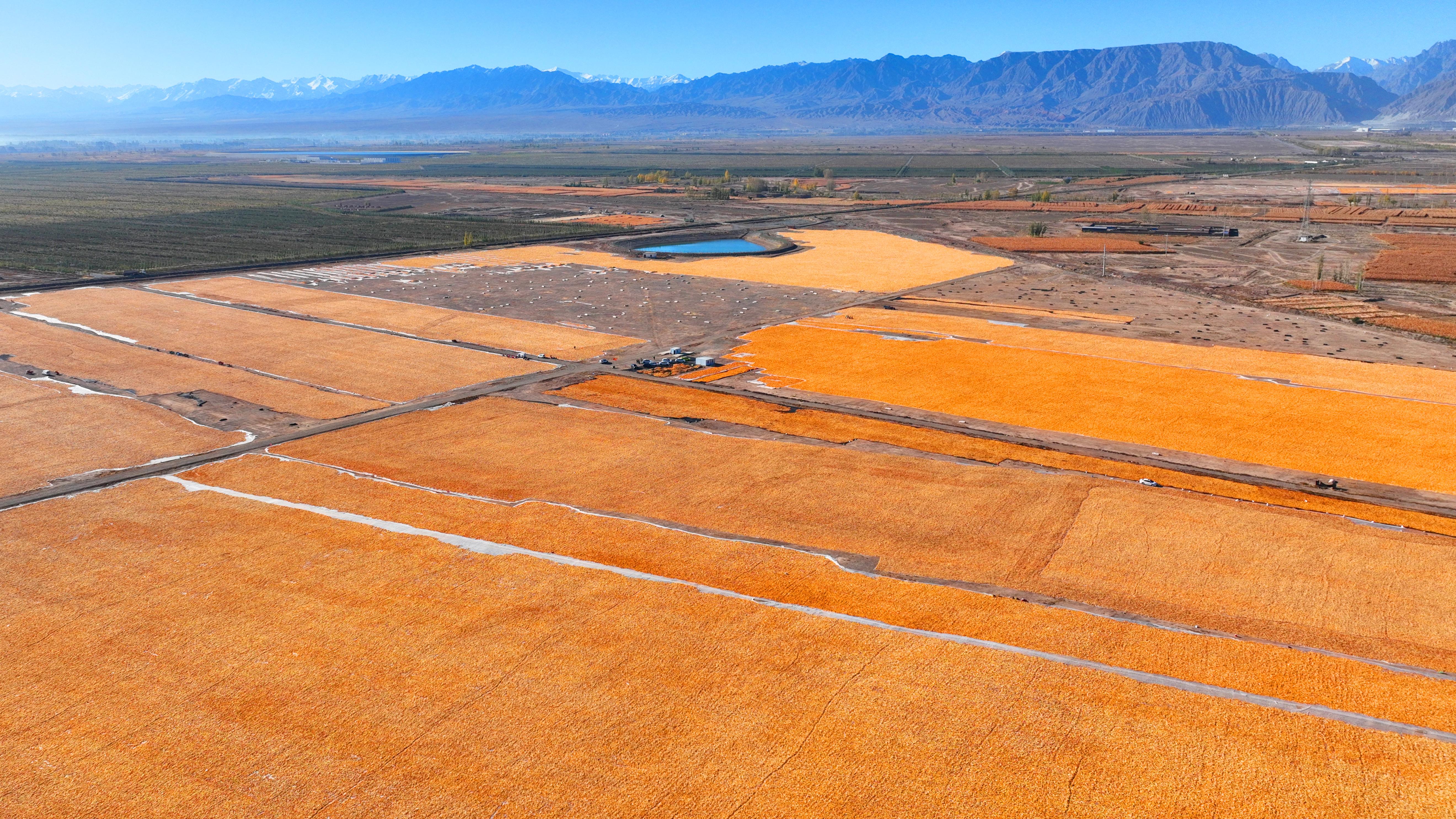
Once eroded by wild wind and sand, the Hexi Corridor is now a modern agricultural region using local conditions to its best advantage, and in the process growing a number of crops popular with consumers. The boundless desolation has transformed into a farmland that nurtures hope.
Modern facility agriculture
The Hexi Corridor, located between the Qilian Mountains and the northern deserts in northwest China, has long been a Silk Road hub that bridges diverse cultures such as nomadism and farming. Although meltwater from the Qilian Mountains has nourished oases and grasslands, the average temperature in the Gobi Desert varies from -40℃ at night to 45℃ in the day, and water evaporation can be more than 10 times that of its rainfall. Cold and drought have always been the biggest constraints that the agricultural development in the Hexi Corridor has had to face.
In the 1990s, agriculture in the Hexi Corridor began to transform to meet market demand. At that time, many people tried to build greenhouses in the Gobi, according to Liu Zhenhua, the Party secretary of Huangjiawan village in Zhangye city, Gansu province, adding that it was not until 2009 that the region mastered the technology to help mitigate severe cold and strong winds.
Local farmers' success in this regard attracted enterprises and research institutes, and received government support. By 2010, technologies such as substrate soilless cultivation had achieved success in the Gobi Desert, and a facility agriculture model featuring more light, less water, new technologies and high efficiency was gradually established.
Zhang Rong, head of the Zhangye Economic Crop Technology Extension Station, said facility agriculture utilized non-cultivated land such as the desert, integrated modern agricultural technologies, and reconstructed the growth environment of crops, thus breaking through the limitation of natural conditions.
Under the guidance of the government, the Hexi Corridor has promoted water-saving technologies and equipment. A total of 7.16 million mu (1 mu equals 666.7 square meters) of farmland with efficient water-saving irrigation has been built, accounting for nearly half of the permanent farmland.
'Golden Corridor' of seed breeding
At the end of autumn and the beginning of winter, the endless Gobi Desert in the Hexi Corridor is covered with patches of golden yellow. These are corn seeds being dried by farmers.
The Hexi Corridor enjoys abundant sunlight, little rainfall, a large temperature difference between day and night, and has few pests and diseases. These factors combine to create a unique natural seed production workshop and laboratory for cultivating stress-resistant seed varieties.
In recent years, with government support for the modern seed industry, Gansu province has championed promotion of the transformation and upgrading of the seed industry in the Hexi Corridor.
Zhang Zongxiang, a seed producer in Zhangye city, has witnessed the industrial upgrade, and said that the harvested corn seeds are directly transported from the fields to seed enterprises for drying, threshing and packaging, reducing the loss caused by sun-drying.
At present, Zhangye's corn seeds have become a renowned product in China, with annual output exceeding 700 million kilograms in its seven major seed production counties.
Meanwhile, the innovation capacity of variety breeding has been significantly improved. Many seed enterprises have adopted breeding methods such as molecular markers and gene editing, which shorten the breeding cycle compared with traditional methods and improve seed resistance to pests and the elements.
Ta Wenshan, the chairman of Jiuquan Huamei Seed Co., LTD., said that the domestic market share of the pepper variety independently cultivated by the enterprise once exceeded 50 percent.
With the continuous advancement of the Belt and Road Initiative, the Hexi Corridor is becoming an important platform for international agricultural cooperation, and an increasing number of researchers from countries such as Pakistan, Tajikistan and Malaysia are visiting to learn from its experience.