
Traffic Safety Test System Gets Smart
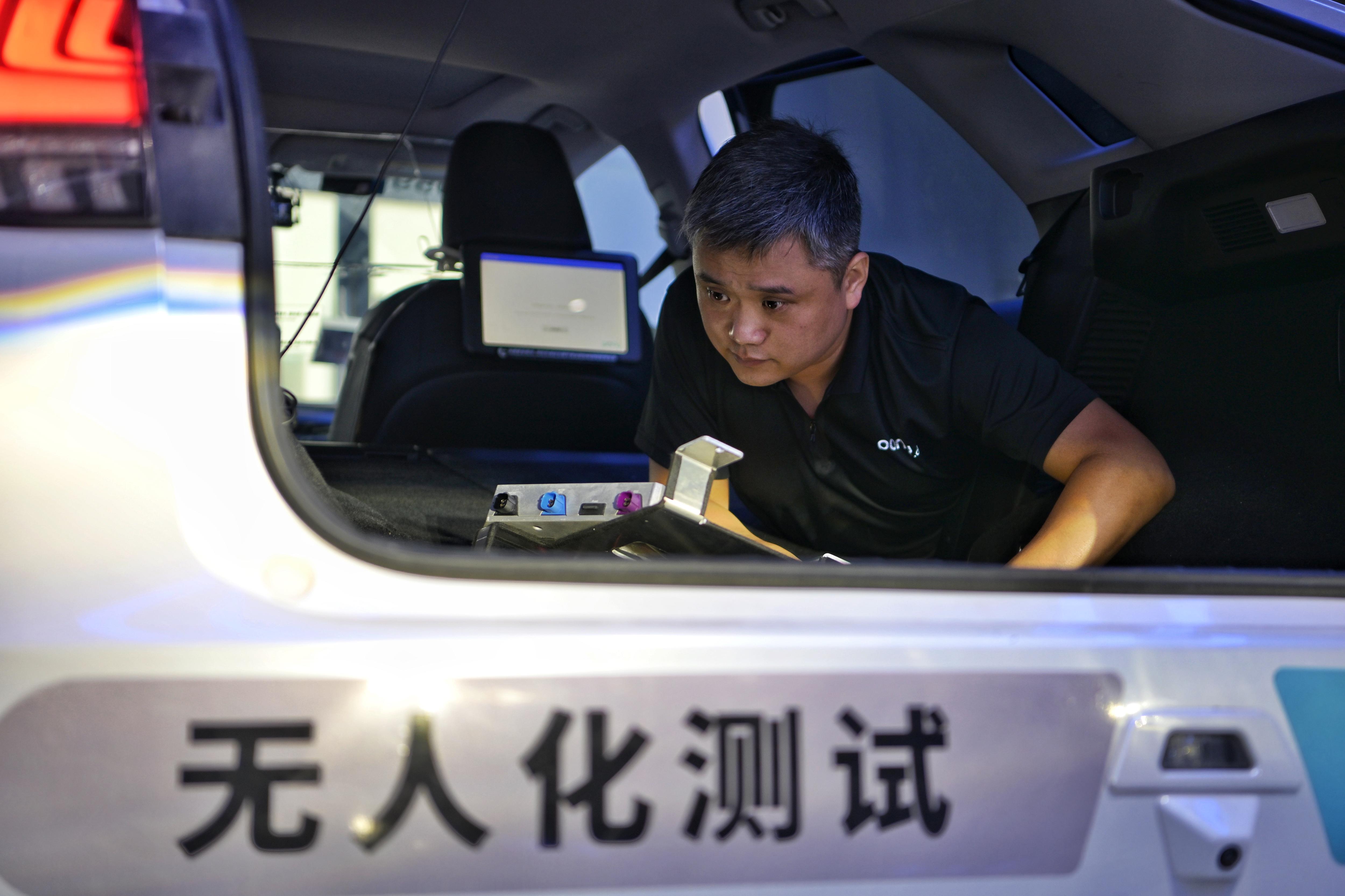
Today, it takes only three days to test vehicles in dangerous scenarios that traditional testing needed half a year.
This is because of the creation of a 'limitless' testing environment for autonomous driving vehicles in a limited physical space by Zhao Xiangmo, president of Xi'an University of Architecture and Technology and professor at Chang'an University (CHU), and his team.
They have developed a traffic safety testing system integrating intelligent in-vehicle terminals, roadside sensing equipment, traffic cloud platforms and trusted testing toolchains for autonomous driving vehicles.
Testing vehicle braking system
The automobile industry gained explosive growth around 2007. At that time, the equipment to test the anti-lock braking system (ABS) had to be mostly imported and only some vehicle parts were tested before assembly. The control effect of ABS for the entire vehicle could be checked only in a test field or on open roads through sampling.
Even field tests and open road tests were not safe enough. Besides, it is impossible to conduct these tests on every vehicle, according to Xu Zhigang, deputy director of the School of Information Engineering of CHU.
The question was how to test the real performance of ABS on each vehicle without disassembling the car by precisely simulating adhesion coefficients for different road surfaces and their combined operating conditions on the test bench.
The research team tried to improve upon German technologies at first, but it didn't work, as they were designed based on European road conditions, which are different from Chinese ones.
After an in-depth survey for half a year, the team took another approach. They built a changeable road surface test bench in the lab by precisely integrating a magnetic powder clutch with a flywheel assembly.
This system can switch between various complex road conditions such as ice, snow and corrugated surfaces within 0.5 second, completing a full vehicle test in 20 minutes. It was a breakthrough in non-disassembly ABS testing on a test bench.
CT for road testing
Another key element is road safety, and bridges play an important part in this.
In 2016, a 20-meter bridge pier on the Xi'an-Hanzhong High-Speed Railway developed cracks. Neither traditional method — core drilling nor ultrasonic testing — was suitable for tackling the urgent risk: the former would damage the structure, while the latter has a detection depth of only two to three meters.
A physical examination in hospital inspired Zhao: What if he conducted computed tomography (CT) on the bridge?
The first challenge was to create an effective detector. Traditional piezoelectric ceramic ultrasonic transducers have limited power, and their sound beams cannot penetrate steel concrete. The team therefore developed a new generation of transducers based on rare-earth magnetostrictive materials.
After 18 months of hard work, the team developed a 24-channel testing system. Coupled with the improved ray-tracing algorithm and CT system, it reconstructs three-dimensional images like "building blocks," achieving a detection depth exceeding 10 meters.
This not only precisely located areas of concrete porosity up to 10 meters deep in the large bridge at a section of the Xi'an-Hanzhong High-Speed Railway, but also realized the first 3D visualization of the bridge's inner defect, said Liu Zhanwen, a member of the research team and deputy director of Shenzhen Research Institute of CHU.
Now the system has been successfully applied in road and bridge engineering projects in many places.
Building a smart brain
Autonomous driving vehicles are developing rapidly, which brings a new challenge: How to ensure they are safe enough?
It is estimated that they have to drive billions of kilometers on open roads to experience all possible scenarios, Zhao said. Traditional testing cannot meet the demand of the fast iteration of technologies.
Here, Zhao's team proposed a virtual-real integration solution, i.e., building a smart and Internet-connected testing base integrating vehicles, roads and cloud technology.
During the test, vehicles driving on real roads, and virtual scenarios, such as pedestrians and extreme weathers, are incorporated via car networking communications, enabling limited physical space to simulate nearly limitless road conditions.
However, the initial simulator motion platform lacked sufficient precision, leading to severe distortion of the vehicle dynamics model. Inspired by the six-degree-of-freedom motion platform of the flying simulator, the research team redesigned the testing system.
On a 52-km all-feature test road in Shandong province in east China, the first of its kind nationwide, testing for scenarios is done in three days. With traditional methods, it would take half a year.
This integrated system has completed over 120,000 hours of equivalent testing, and some of its standards have been adopted by 16 domestic and international regulations.