

Siku Quanshu: Largest Collection of Chinese Books
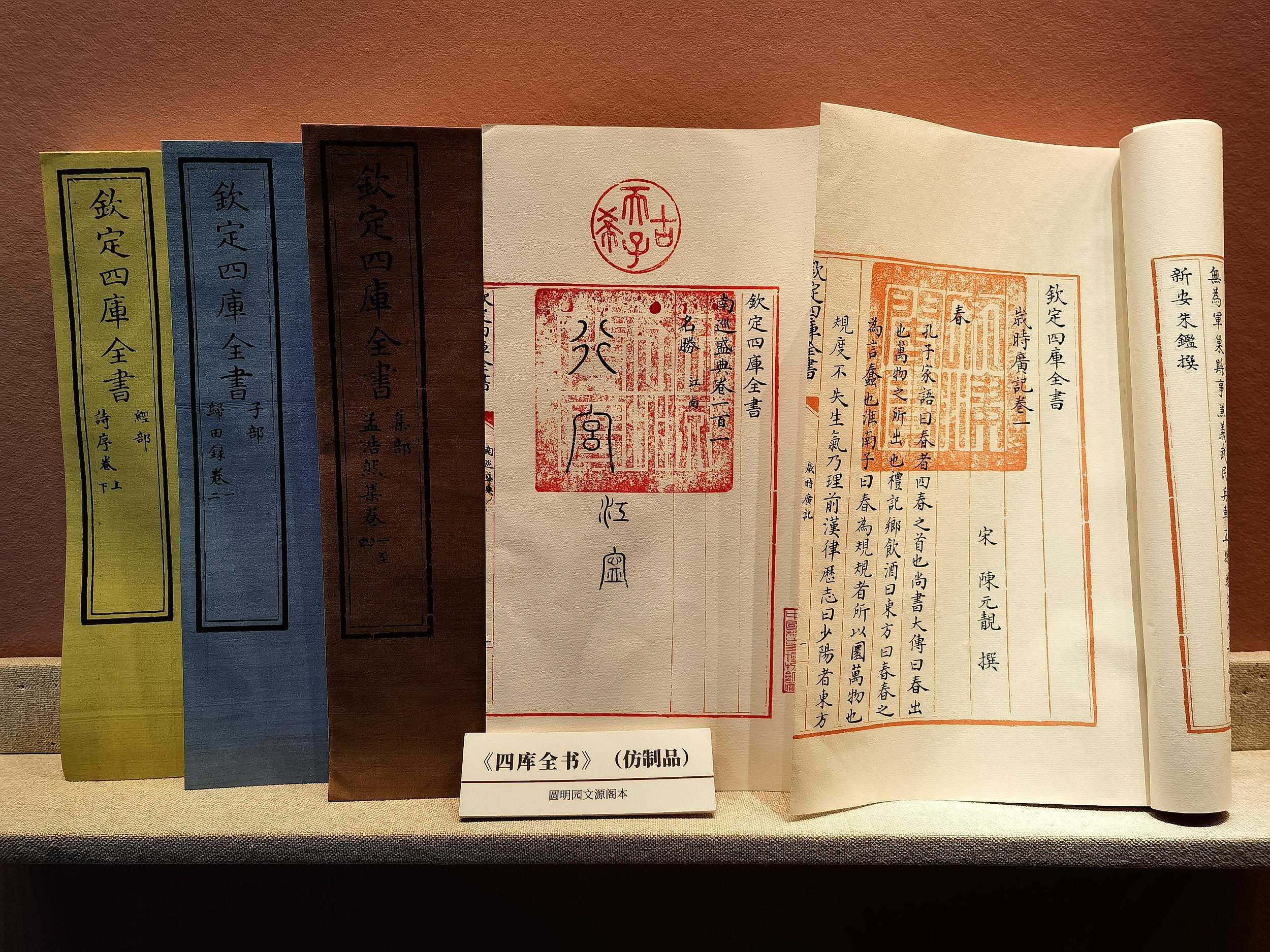
The Siku Quanshu or the "Complete Library in the Four Branches of Literature," is a Chinese encyclopedia commissioned during the Qing dynasty by the Qianlong Emperor. Commissioned in 1772 and completed in 1782, the Siku Quanshu is the largest collection of books in imperial Chinese history, comprising 36,381 volumes, 79,337 manuscript rolls, 2.3 million pages, and about 997 million words.
The initial compilation of the Siku Quanshu began with the Siku Quanshu Zongmu Tiyao bibliography, which was completed by 1773. The first workable drafts were completed in 1781. These included bibliographical information on all the works included in the Siku Quanshu in full, as well as a large number of works that are mentioned only by title.
As indicated by its title, the Siku Quanshu has four categories, which reference the divisions of the imperial library: "Classics or Jing(经)" is the canon ramified by Confucius since the Han dynasty (202 BC-220 AD); "Histories or Shi(史)" is the collection of works related to history, geography, official positions, political affairs, and biographies; "Masters or Zi(子)" are texts focusing on philosophy, arts, and sciences; "Letters or Ji(集)" contains literature such as poetry and personal letters, and writings meant for the masses.
In the course of editing, a large number of corrections were made to local records. Personal documents, often describing the actions of noteworthy local people, were often included in the Annotated Bibliography of the Four Treasuries if their contents could be verified through central government records. In the Siku Quanshu itself, documents that could not be verified were often included by title only. Even officially sponsored writings, such as local gazetteers, were not safe from the scrutiny of the compilers.
Medical knowledge was often documented through case studies, on the model of 25 instances in Sima Qian's Records of the Grand Historian, which combined narrative with analysis.
Similarly, works on philosophy took Huang Zongxi's writings as their model, though they came to be divided into two types: "archival," meaning scholarly articles, and "cultural," meaning Buddhist koans. Because authors and previous compilers had not considered philosophical works to form part of historical records, the compilers of the Siku Quanshu redefined the classifications in several compilations and set boundaries based on authors' biographies and the purposes of their writings.
The Siku Quanshu was the largest cultural project in ancient China, providing the most systematic and comprehensive summary of classical Chinese culture. It exerted tremendous influence on later academic circles, both in terms of methods for collating ancient books, recovering lost texts, textual criticism, and bibliography.