

Low-altitude Economy Takes Off in China in 2025
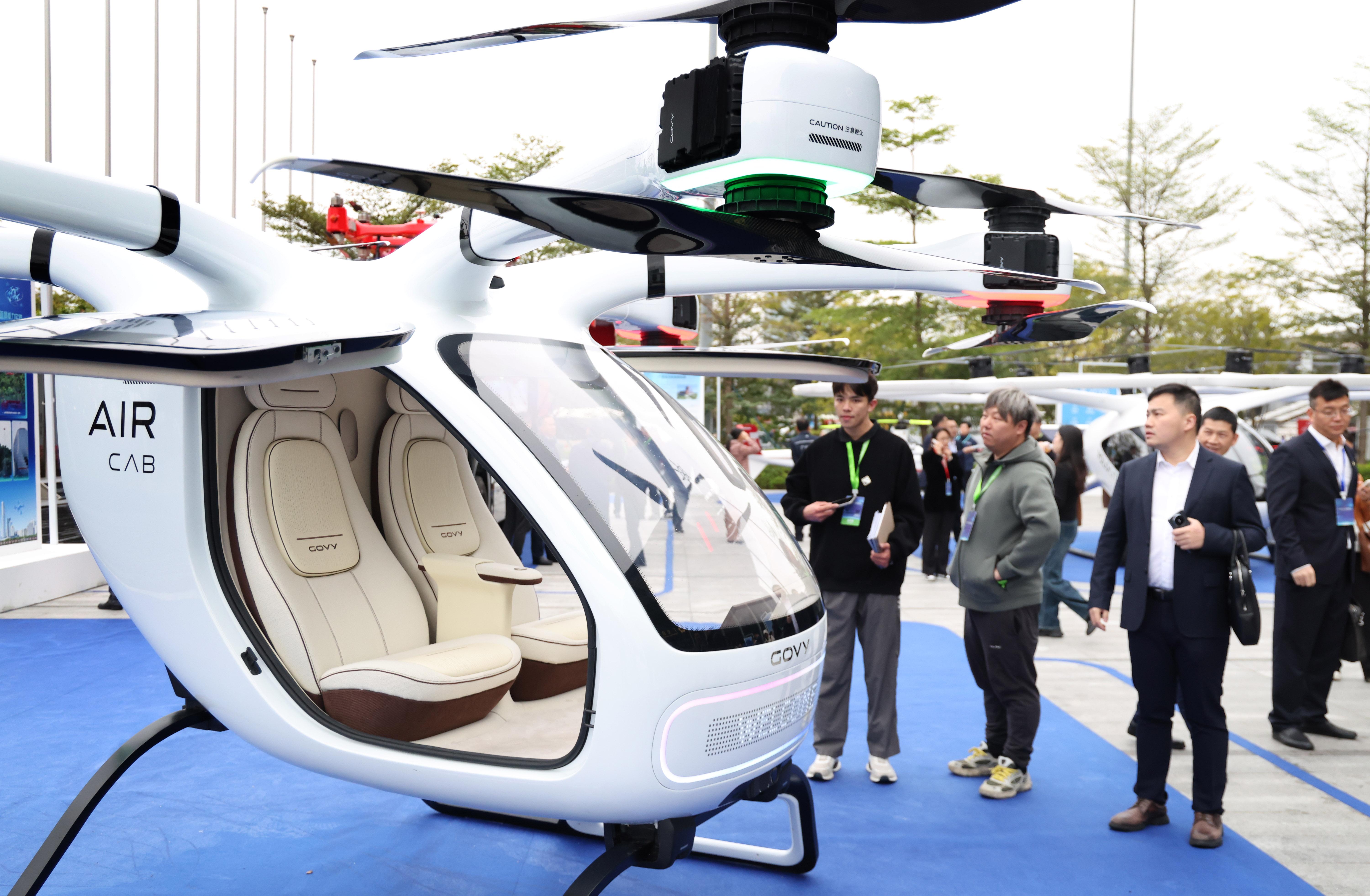
China's low-altitude economy is flying through a period of rapid expansion. This is being driven by supportive policies and rapid technological iteration, and it has become a key area for developing new quality productive forces and building a trillion-RMB emerging industry.
In 2025, driven jointly by policy guidance, technological innovation and real-world deployment, the sector achieved a pivotal shift from exploratory development toward scaled and standardized growth. The policy framework has continued to develop, breakthroughs in key technologies have accelerated, application scenarios have diversified, and infrastructure networks have begun to take shape.
Flying cars are a crucial part of the low-altitude economy. According to a report on flying car development released recently, flying cars are expected to experience a commercial takeoff between 2025 and 2030, with application scenarios progressing along two parallel tracks: professional use and mass-market adoption.
"Professional scenarios will see the first breakthroughs, with emergency rescue, upgrades to police equipment, and highway monitoring among the earliest application areas," Wang Zhihong, chief engineer of the High-tech Industry Department at the China International Engineering Consulting Corporation, told Science and Technology Daily.
"Mass-market scenarios will follow a progression in which cultural tourism comes first, short-distance connections follow, and urban commuting comes last. At present, cultural and tourism flight projects by companies such as EHang have already been launched. Short-range connections between airports and urban areas, as well as intercity transport within urban clusters, will become the next focus for large-scale deployment, while intra-city commuting will be advanced gradually as a longer-term goal," said Wang.
Despite gaining momentum, the large-scale development of the flying car industry still faces multiple systemic challenges, in fields like payload and range, airworthiness safety, intelligent flight control and power systems.
To address these challenges, Wang proposed a systematic approach centered around "policy guidance, technological coordination, industrial integration and scenario-based demonstration."
At the policy level, Wang called for the establishment of airworthiness certification mechanisms, airspace management systems and regulatory standards specifically designed to accommodate the technological evolution and mass-production demands of flying cars. On the technology front, he suggested forming collaborative working groups on low-altitude flight technologies to collectively address common challenges in areas such as flight control and power systems.
In terms of industrial integration, Wang emphasized leveraging the roughly 70 percent technological overlap between flying cars and new energy vehicles to reduce costs and improve efficiency, while strengthening domestic production and independent control of core components.
Zheng Yali, assistant secretary-general of the China Society of Automotive Engineers, said that as a key vehicle of the low-altitude economy, flying cars will extend the automotive industry into low-altitude airspace and reshape future three-dimensional transportation systems. This will ultimately help to achieve integrated air-ground mobility.
"The integration of flying cars into everyday life will be a phased and incremental process, advancing in tandem with technological progress, expanding scenarios and ecosystem maturity," Zhang Yangjun, a professor at Tsinghua University's School of Vehicle and Mobility, said.
In his view, the next five years will focus on demonstration projects and ecosystem growth, the following ten years will mark the initial stage of large-scale application, and the next twenty years should see fully integrated three-dimensional development, potentially ushering in a stable era of air-ground integrated transportation.