

China, A Place to Grow and Contribute Meaningfully
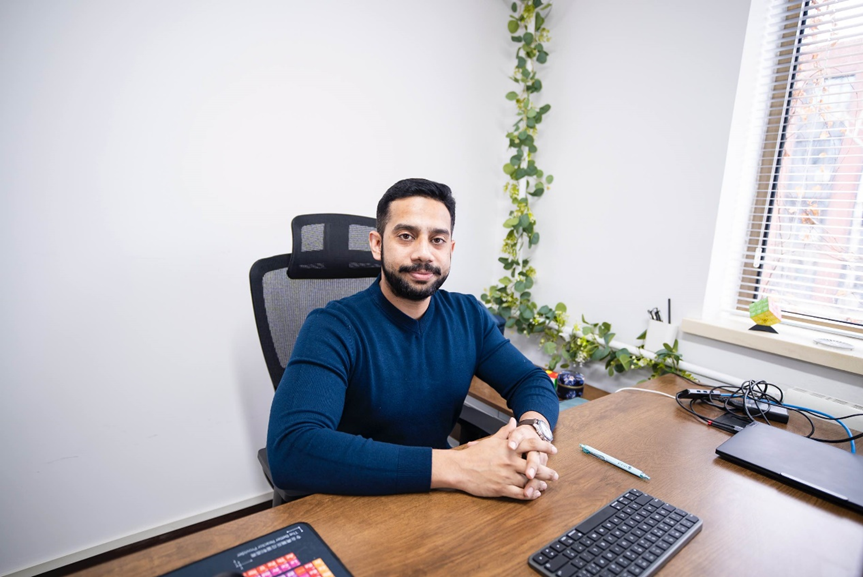
In 2017, when Pakistani scholar Muhammad Salman Nasir first arrived in China to begin his PhD, he had a clear scientific mission: to advance catalytic technologies for renewable energy. What he didn't anticipate, was how deeply the country would shape his sense of purpose and belonging.
"Beyond my research, my time in China, moving from Xi'an to Shanghai, and now [to] Tianjin, has profoundly influenced both my personal growth and professional perspective," Nasir said. "What started as a pursuit of a PhD transformed into an immersion into the living, breathing fabric of Chinese society."
A deliberate choice
Currently, Nasir is an associate professor at the State Key Laboratory of Engines at Tianjin University (TJU). "My decision to pursue doctoral studies and a research career in China was really driven by three key factors: academic ambition, alignment with global sustainability trends, and the unique research ecosystem here," he said.
At the time, China was accelerating its commitment to the "Dual Carbon" goals, aiming to peak emissions before 2030 and achieve carbon neutrality by 2060. That national vision, combined with massive investment in hydrogen, solar fuels, and carbon utilization, convinced him this was where research could make a real impact. "China's emergence as a global leader in clean energy research presented an incredible opportunity," Nasir said.
He chose TJU not just for its reputation. "My lab is renowned for interdisciplinary energy research, bridging materials science, chemical engineering, and mechanical systems, which perfectly matched my integrated approach to catalyst and reactor design," he said. He also appreciated the university's strong industry ties and support for international researchers.
Science that serves society
Nasir's current work focuses on using sunlight to turn CO2 and plastic waste into green hydrogen, sustainable fuels, and useful chemicals. Rather than chasing small improvements, he aims for solutions that can scale up. "Instead of isolated projects, I see my work as contributing to an integrated toolbox for green transformation," he said.
Nasir stressed that university labs play a special role in the transition to carbon neutrality."University laboratories, like the one I work in at TJU, are innovation hubs where big ideas meet real-world challenges. We serve as essential testing grounds for high-risk, high-reward technologies, those that industry may see as too uncertain but that hold transformative potential."
Importantly, his team designs with global access in mind. "The solutions we're advancing, low-cost, modular, and solar-powered, are designed to be adapted and scaled in varied contexts," he said. "By sharing these technologies and the knowledge behind them, we aim to support countries in leapfrogging fossil fuel dependency."
The culture of collaboration
Nasir has been consistently impressed by the students and young researchers he works with. He noted their diligence, technical skill, and ability to connect lab work to bigger social goals. "Their thinking is often highly strategic. They quickly grasp not only the 'how' of an experiment but also the 'why' behind it, aligning their work thoughtfully with broader scientific and national sustainability objectives," he said.
He also values the cross-disciplinary teamwork in his lab, where chemists, materials scientists, and engineers regularly collaborate on complex energy problems. This spirit, he added, reflects China's wider research environment: well-funded, strategically focused, and increasingly open to global talent."This environment has been instrumental to my work," Nasir said. "The strategic alignment with national energy priorities gave my research on solar-driven hydrogen and CO2 conversion a clear sense of purpose and relevance."
A home, not just a workplace
In China, Nasir has found a sense of community. "From morning tai chi sessions to lively debates on AI and sustainability in campus cafés, there is a tangible spirit of collective aspiration, where education is viewed not just as personal advancement, but as a contribution to the broader society," he said.
Beyond the university, China's cities shaped his view of modernity. "You can taste centuries of history in a bowl of hand-pulled noodles, then minutes later ride a high-speed train or pay for groceries with your phone. This seamless coexistence of old and new taught me that modernization in China doesn't erase tradition — it converses with it."
He also spoke warmly of everyday kindness: strangers offering help on the subway, vendors remembering his order, colleagues inviting him to Mid-Autumn Festival dinners. "I felt a consistent culture of warmth and mutual respect," he said.
For Nasir, his academic journey has come full circle. He came seeking a place to do meaningful science and over time, that place has become much more. Nasir has stayed because he found something rarer: a place where his work, his family, and his values all fit.