

Decoding Autonomous Driving in Mountainous Chongqing
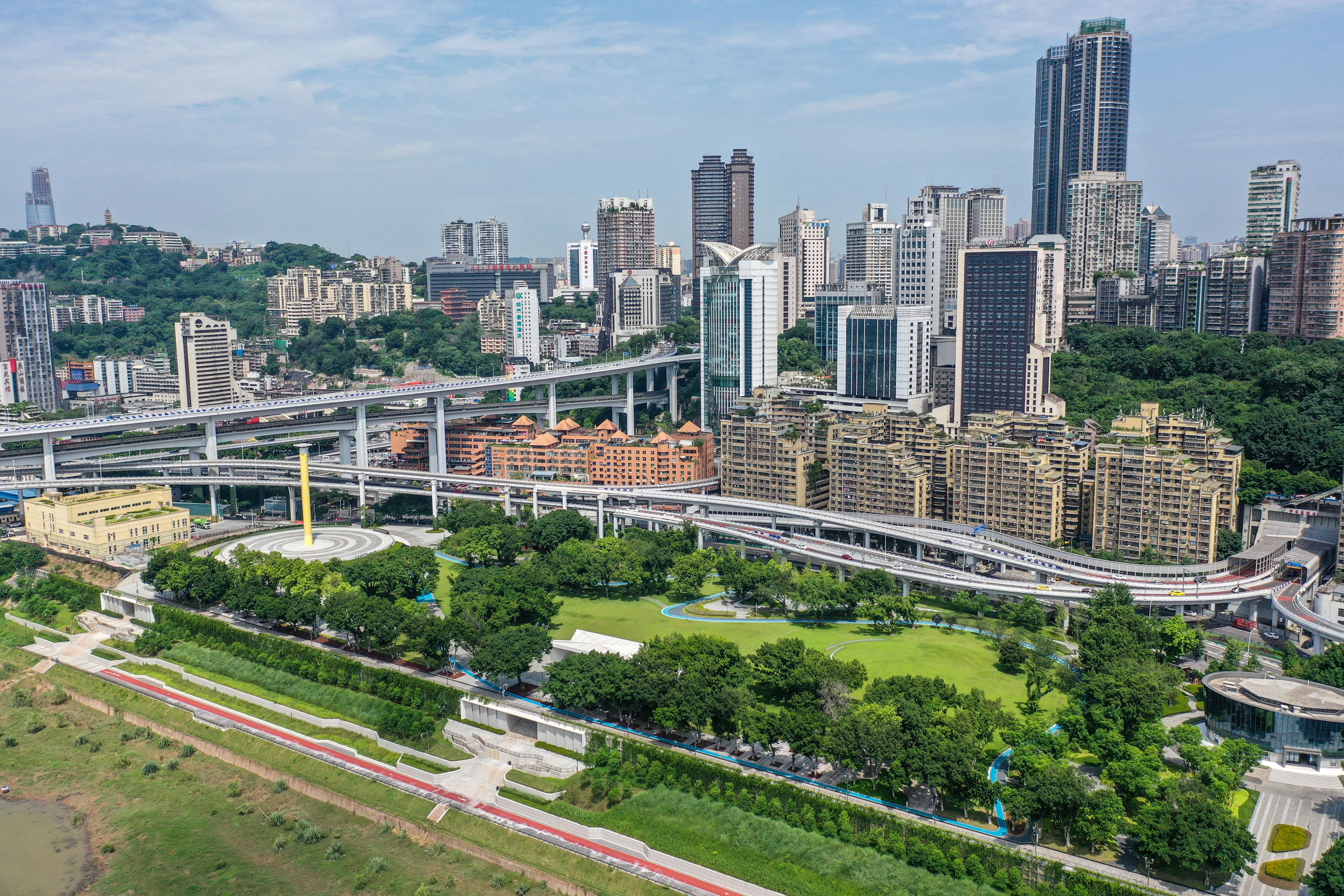
As a mountain city, Chongqing is well known for its complicated and multi-tiered road network. But this also makes it a perfect test field for intelligent connected vehicles (ICVs) and autonomous driving technologies.
Chongqing University of Posts and Telecommunications (CQUPT) spearheaded the establishment of a municipal key laboratory for ICVs and vehicle-road coordination, conducting basic research and tackling key technological bottlenecks. The focus is on trustworthy perception, high-precision positioning, safety-oriented cooperative control, and vehicle-road-cloud integration.
"Traditional algorithms work well on plains, but not in Chongqing," Li Yongfu, head of the lab and a professor at the School of Automation of CQUPT, said.
Multi-level flyovers complicate path planning, while the urban canyon effect created by high-rise buildings leads to frequent GPS signal loss, Li said, adding that consecutive tunnels and steep slopes can instantly render vehicles relying on optical sensors effectively "blind."
A core issue that must be resolved for autonomous driving to achieve mass adoption in mountainous cities is ensuring that ICVs can operate safely, smoothly and efficiently despite incomplete perception, unstable positioning, communication latency and frequent traffic disturbances.
Rather than immediately rewriting code, researchers at the lab worked on modeling. They began by examining the system-level coupling among vehicles, roads, the cloud, humans and the environment, conducting an in-depth analysis of vehicle motion under complex disturbances.
This is like doing a dissection for the mountain city's transportation. The researchers not only need to know where the traffic congestion is, but also why there is congestion and how vehicles interact in this process.
Cen Ming, a professor at the lab, said logistics is one of the most promising sectors for the large-scale deployment of autonomous driving. Although roads in ports and parks are relatively closed, their operating conditions are highly complex. Autonomous vehicles operating in these environments must cope with key challenges such as uncertainties in environmental perception, positioning degradation caused by global navigation satellite system (GNSS) signal blockage, and insufficient reliability of autonomous decision-making in complex scenarios.
The laboratory established a collaborative multi-source perception mechanism for complex scenarios by overcoming technical barriers in the integration of information from multiple sensors, including vision sensors, LiDAR and millimeter-wave radar.
To address the widespread challenge of GNSS signal blockage in mountainous areas and ports, the team developed a high-precision positioning technology that integrates satellite navigation, inertial measurement and environmental perception, keeping vehicle positioning error within 10 centimeters.
The lab has developed a full-chain autonomous driving technology system covering perception, localization, decision-making and control. The system has been fully validated in real-world open-road scenarios, providing replicable and deployable solutions for the large-scale deployment of autonomous driving in scenarios such as urban last-mile delivery, industrial park logistics and port cargo transportation.