

Advancing Basic Science for Humanity: The Vision of 2026 Beijing ICBS
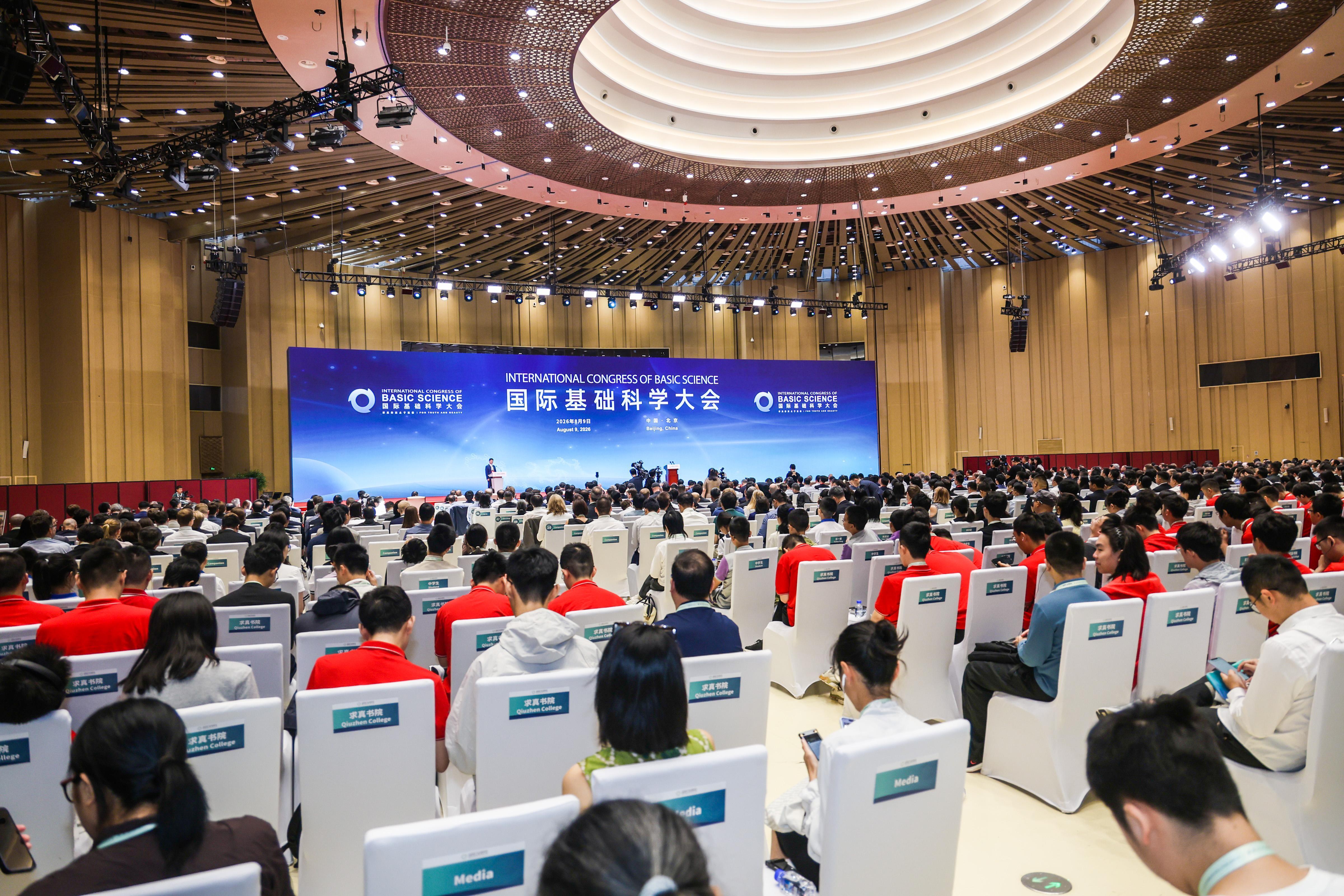
"The Chinese government has made an unprecedented commitment to basic research. From sustained funding and long-term strategic planning to talent recruitment and the development of research platforms, China has become increasingly fertile ground for fundamental research," Shing-Tung Yau, chair of the International Congress of Basic Science (ICBS), said in his opening address at the 2026 ICBS.
The congress, which opened at the Yanqi Lake International Convention and Exhibition Center in Beijing on August 9, drew more than 400 distinguished scholars from around the world, along with over 800 researchers and students from universities, academic organizations, and research institutions across more than 30 countries and regions. Aligned with Beijing's core strategic blueprint for building a world-class international center for sci-tech innovation, it is a vital academic hub that brings together the world's leading minds and fosters foundational, original, and potentially transformative scientific breakthroughs.
Nine distinguished scientists received the ICBS Medal: mathematician Claire Voisin, mathematical physicist Horng-Tzer Yau, number theorist and algebraist Shou-Wu Zhang, theoretical physicist Andrea J. Liu, experimental particle physicist Wang Yifang, theoretical condensed matter physicist Xiao-Gang Wen, chemical engineer and materials scientist Bao Zhenan, biophysicist Zhuang Xiaowei, and molecular biologist Zhang Feng.
The ICBS Medal recognizes groundbreaking and revolutionary achievements in basic science worldwide and celebrates extraordinary contributions to scientific progress. The medals span three major disciplines, mathematics, physics, and engineering, and are named in honor of nine scientific giants: Emmy Noether, Shiing-Shen Chern, Andrew Wiles, Marie Curie, Samuel C.C. Ting, David Gross, Chien-Shiung Wu, Steven Chu, and Charles Kuen Kao.
During the sharing session, several award-winning scientists turned their focus to the long-term value of basic science and the driving force of curiosity. Zhuang Xiaowei, professor at Harvard University, said: "One of the most precious characteristics of basic science is that, at the outset, exactly how our research will turn into a product that directly impacts our everyday life is often not immediately clear." Yet she emphasized that returns do come, often from directions not originally intended.
"Many tools and knowledge now transforming modern technology and medicine were not discovered for the purpose we use them today. They came from scientists simply trying to understand the nature and underscores the importance of basic science," Zhuang added.
Bao Zhenan, K.K. Lee professor of chemical engineering at Stanford University, said: "Science begins with curiosity. It begins with the excitement of discovering something that no one has known before. The prize is the pleasure of finding things out. I could not agree more."
Addressing the impact of AI, Shing-Tung Yau said in recent years, AI has emerged as an important tool for basic science, with continued achievements in AI-assisted mathematical and scientific research and demonstrating remarkable efficiency and capability. Yet he remains convinced that "original thinking, spontaneous inspiration, and the eternal quest for truth and beauty in science are uniquely human endeavors that will continue to drive the major revolutions in basic science through interdisciplinary thought and the courage to explore the unknown."
Andrea J. Liu, Hepburn Professor of Physics at the University of Pennsylvania, said: "In these times, when technology is so dominant in the public conversation and people even wonder whether AI is better at science than scientists, the importance of basic science requires more emphasis than ever. Similar to radioactivity, the inspiring fundamental discoveries that people are making today might contain the seeds of the technology of tomorrow."
Yau also noted that last month, two Chinese mathematicians, Wang Hong and Deng Yu, achieved landmark theoretical breakthroughs and were awarded the Fields Medal, one of the highest international honors in mathematics. "These two major achievements resonated throughout the international mathematical community and inspired extraordinary enthusiasm for fundamental research at home and abroad. This is both a historic opportunity for scientists of our time and an exceptional stage upon which a new generation of young scholars can demonstrate their talent," he said.
Quoting mathematician David Hilbert's resounding declaration from nearly a century ago, "We must know. We will know," Yau said: "That unwavering commitment to truth has echoed across the decades and remains alive in the heart of every scientist. May we remain true to the original spirit of scholarship, and on the journey of basic science advance with conviction toward truth and beauty."
The Frontiers of Science Award recognized 111 high-impact original research papers in basic science spanning 40 specialized research directions across the three major fields of mathematics, physics, and information science and engineering. The recipients came from universities, research institutes, and technology enterprises across more than 20 countries and regions. Papers by Chinese scholars focused on cutting-edge topics including geometric analysis, quantum theory, AI large models, and computer vision. To nurture young and mid-career innovators, the congress established the ICBS Innovative Scholars Program, designed for outstanding researchers working full-time in China who demonstrate exceptional potential for groundbreaking innovation, supporting "from zero to one" innovations in basic science.
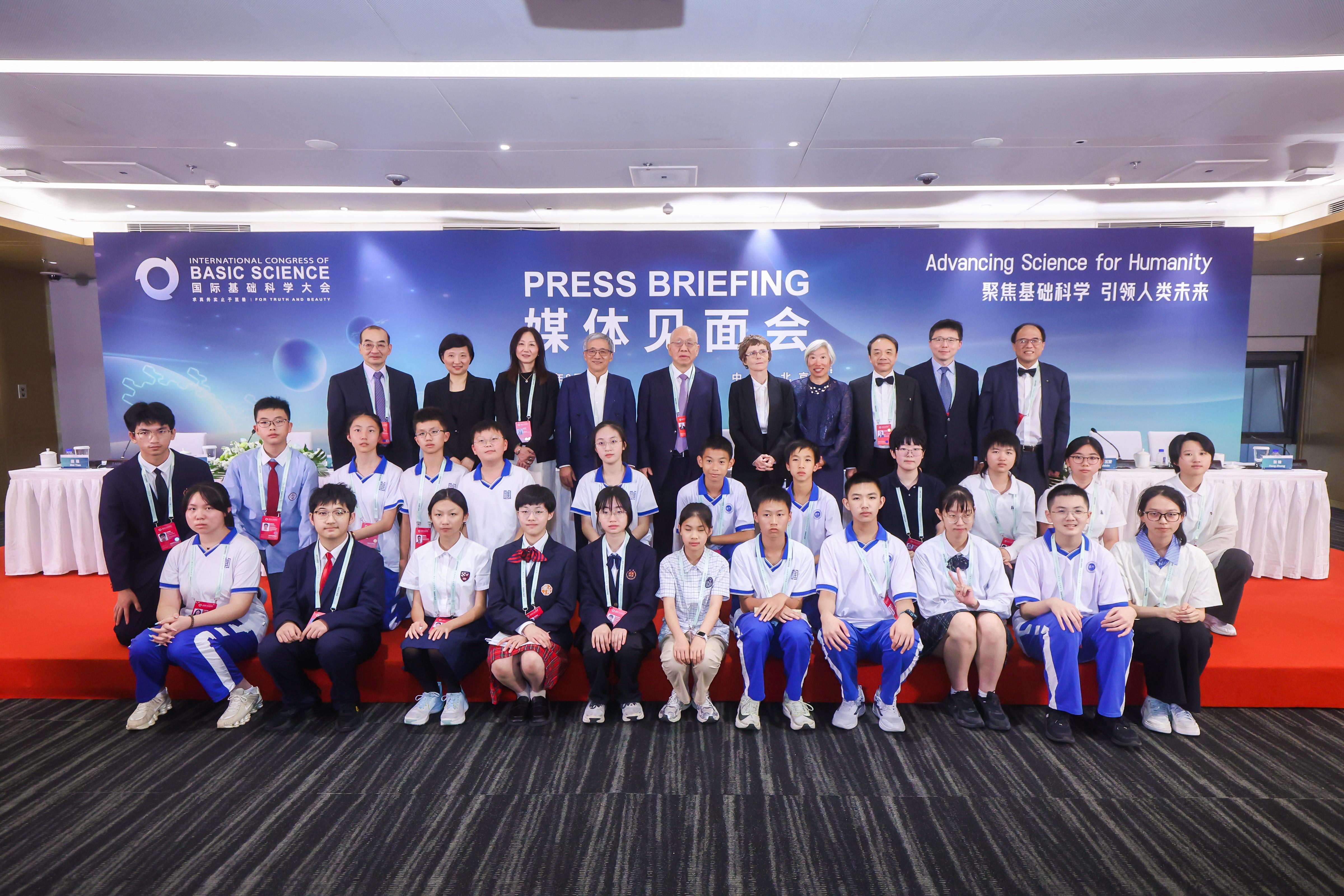
In the press briefing, deepening international cooperation emerged as a core consensus among the participating scientists. Yau stressed that scientists must work together, share resources, and collectively advance further development of basic science. Zhang Feng, a researcher at the Broad Institute of MIT and Harvard, said supporting basic science is about building a repository of knowledge for the entire world, and he saw this not as competition but as contributions to the enrichment of humanity's shared knowledge base.
The ICBS was initiated by Shing-Tung Yau in 2023, with the theme "Advancing Basic Science for Humanity." This year marks the fourth time it has been held in Beijing.