

The Romanian Sinologist Who Spent 20 Years Translating One Chinese Book
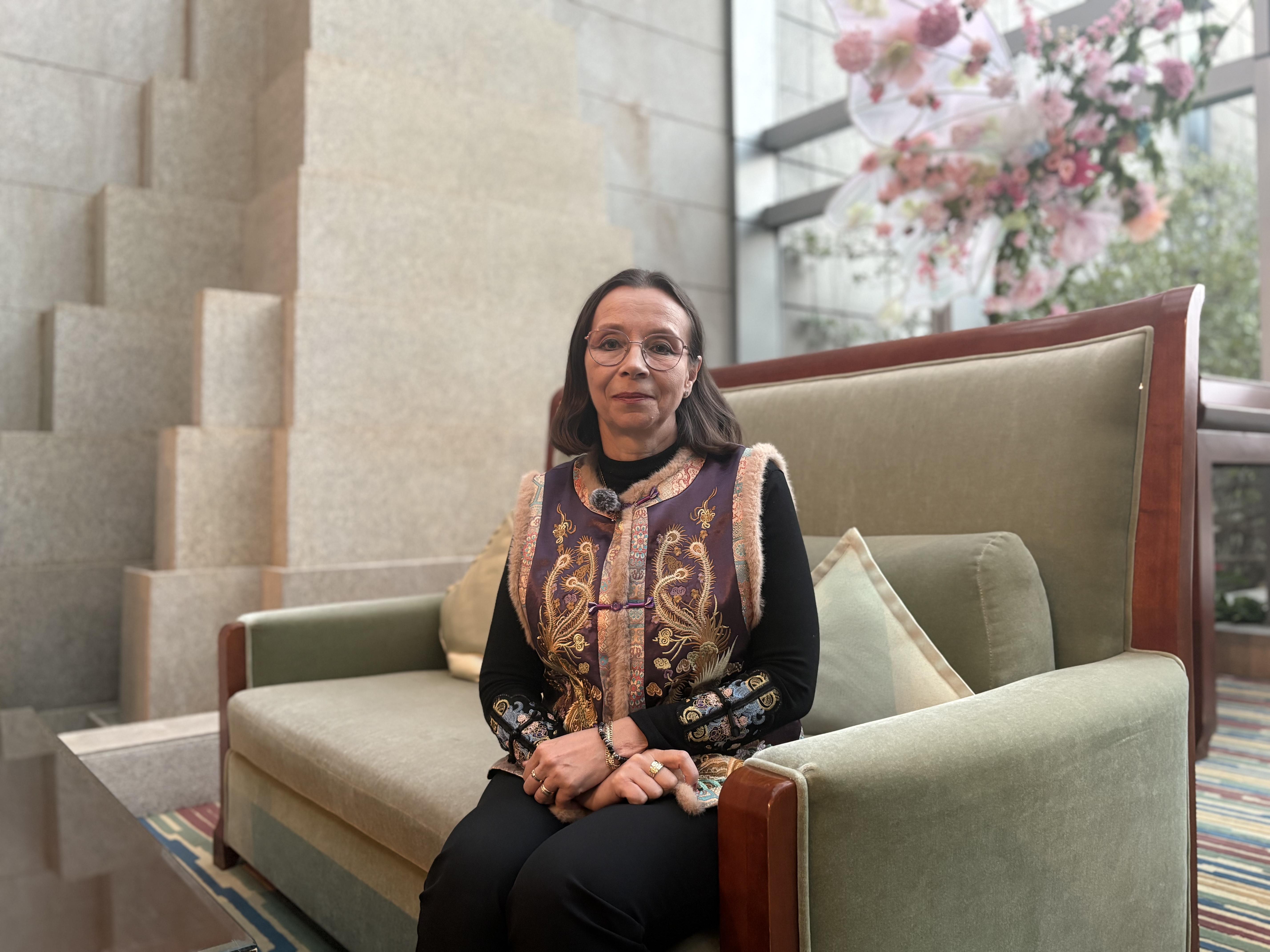
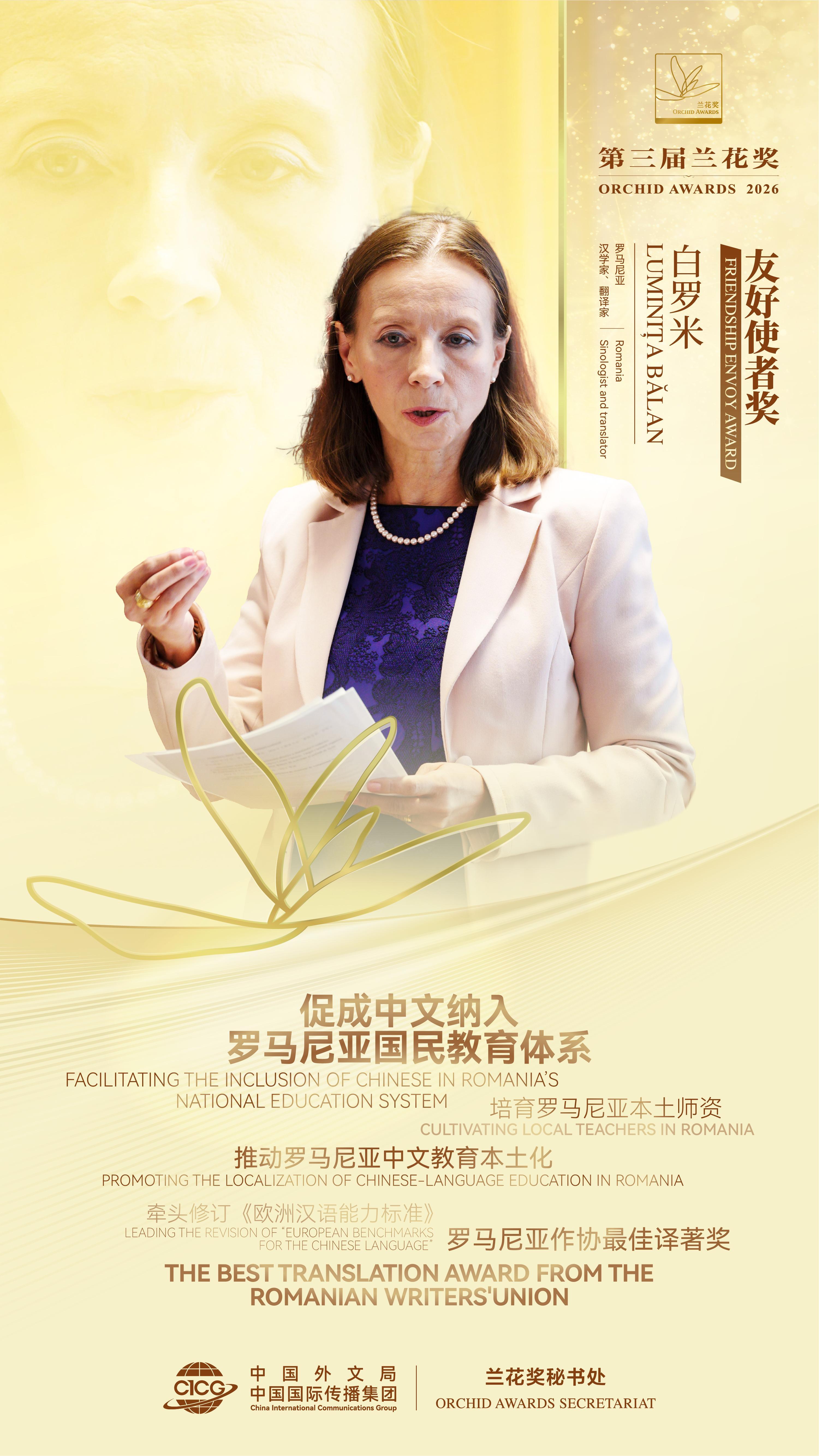
Professor Luminița Bălan had come to Beijing to receive the Friendship Envoy Award for her decades of work promoting Chinese language and culture in Romania. Instituted by the Orchid Awards established by the China International Communications Group in 2022, the honors acknowledge foreign individuals and institutions that have made outstanding contributions to cultural exchange between China and the world.
Bălan is a professor at the University of Bucharest and the foreign director of the city's Confucius Institute. She spent 20 years translating into Romanian the Zhuangzi, one of the foundational texts of the Daoist philosophy that urges readers to align with the natural flow of the universe (Dao) and not fight it or try to over-control life.
Subsequently, she has rendered dozens of Chinese classics and modern novels into her native language. Her first encounter with Chinese was in the early 1970s, when she was seven and saw characters chalked on a blackboard in a Romanian schoolroom.
One character a day
Bălan's road to Chinese was a slow one. She studied the language a lesson a week through primary and secondary school, then won a place at the University of Bucharest to read Chinese and English. She graduated in 1990, stayed on to teach, and began doctoral work that has never really finished.
Her students arrive with different reasons for learning Chinese she never tires of collecting. Some are drawn to the sound of the language. Some want to know how the characters changed over time. Some watched Chinese films, or read Chinese myths, or simply want to understand how a country with such old roots grew so fast.“They all want to get inside Chinese culture,”she said, sitting down with Science and Technology Daily.
For Bălan, Chinese long ago stopped being a subject and became a routine, then a habit, then something closer to a way of living. She carries a small notebook where, in exquisite penmanship, she copies one or two new Chinese characters each day. She has done this for most of her adult life. “If I forget one, I am disappointed with myself. Then I write it again.”
“Chinese is hard,”she tells the first-year students she meets each September.“But if you keep going, you will learn it. And you will become people with a future.”
Twenty years, one book
The work that defined her career began shortly after graduation. Working with the famed Romanian sinologist Tatiana Segal, she decided to translate a Chinese classic directly from the original. The Analects, the collection of the sayings and ideas attributed to Confucius and his contemporaries, and the Daodejing – the Classic of the Way and Virtue, traditionally attributed to the sage Laozi and considered a foundational Daoist text – already had Romanian versions, so they chose the Zhuangzi. The problem, they found almost at once, was that it was written in classical Chinese.
“We realized we could not translate it on instinct,” she says. “So we put the book aside and went back to study classical Chinese properly.”
The Zhuangzi took 20 years. When it came out in 2009, it arrived heavily annotated, Bălan's attempt to make a difficult text feel approachable to the Western reader. She went on to translate the Xunzi alone, another classic text covering a wide range of subjects, from education, ritual and music to ethics, politics, and warfare. Recently, she finished the Mencius, an anthology of conversations and anecdotes attributed to the Confucian philosopher Mencius, with a former student who now teaches Chinese in Brașov; the book is in revision and she hopes to publish it next year.
She also translated modern Chinese fiction into Romanian, two of Mo Yan's novels after his Nobel Prize in 2012, followed by authors Yu Hua, A Cheng and Liu Zhenyun. For this work the Romanian Writers' Union gave her its award for best translation.
“Translation is not just a linguistic conversion,” she says. “It is a bridge between cultures, a bond that connects different worlds.”
What the ancient books still say
To Bălan, who has spent more than half a century reading Chinese, the culture carries three qualities that have stayed with her through all those years: it is wise, disciplined and enchanting.
The wisdom is the kind that has had time to settle. Concepts such as ren (benevolence), xiao (filial devotion), li (propriety) and yi (righteousness) are not abstract or outdated concepts. She has her students read the Analects, then go and look. Those who spend a summer in China come back with the same findings: meeting young people who sow filial piety, take care of their grandparents, and are deferential to their teachers.
“The philosophy is not locked in the classics,” she says. “It is being lived. Chinese people take nourishment from these books, and we can too.”
The Zhuangzi taught her the other half. Its Daoist author, full of fables and jokes, is often easier for a Western reader to understand than the tight, spare lines of the Daodejing. Read together, she thinks, the classics give you not a monolithic China but a layered one, disciplined and free at once.
However, what has shaped her view most is not the texts but the connection between people. Every visit to China brings the same warmth, invitations, gifts. “I keep saying you are too generous, we are friends, there is no need for all this trouble,” she says. “But they reply that precisely because we are close friends, they want to seize every chance to show their respect.”
She says this is what convinces her that exchange between civilizations is worth taking seriously. The old books gave her a way to understand China. The people she meets there keep proving that understanding runs both ways.