
Crackdowns on Chinese Lidar Can't Mask U.S. Industry Plight
Recently, Raja Krishnamoorthi, a Democratic ranking member of the U.S. House Select Committee on China, introduced the so-called Stopping Adversaries From Exploiting LiDAR Act (Safe Lidar Act), calling for the gradual removal of Chinese-made Light Detection and Ranging (lidar) systems currently used in the United States and a ban on new imports after three years. Exceptions would apply only for limited purposes such as scientific research or cybersecurity testing. Lidar is a remote sensing method used to examine the surface of the Earth.
In his statement, Krishnamoorthi claimed — without evidence — that Chinese lidar products pose a threat to U.S. national security. He argued that the United States must ensure such systems are built by "trusted partners" and insisted that the U.S. and its allies should lead innovation in lidar technology rather than "ceding control of this critical technology to foreign adversaries."
It's a typical example of the old playbook of American politicians banning Chinese sci-tech products from going to the U.S. market by tarnishing them. This rhetoric follows a well-worn pattern. By framing Chinese technology products as security risks, some U.S. politicians seek to block their access to the American market, suppress the development of Chinese industries, and clear space for domestic companies — an approach reminiscent of Washington's earlier campaign against Huawei.
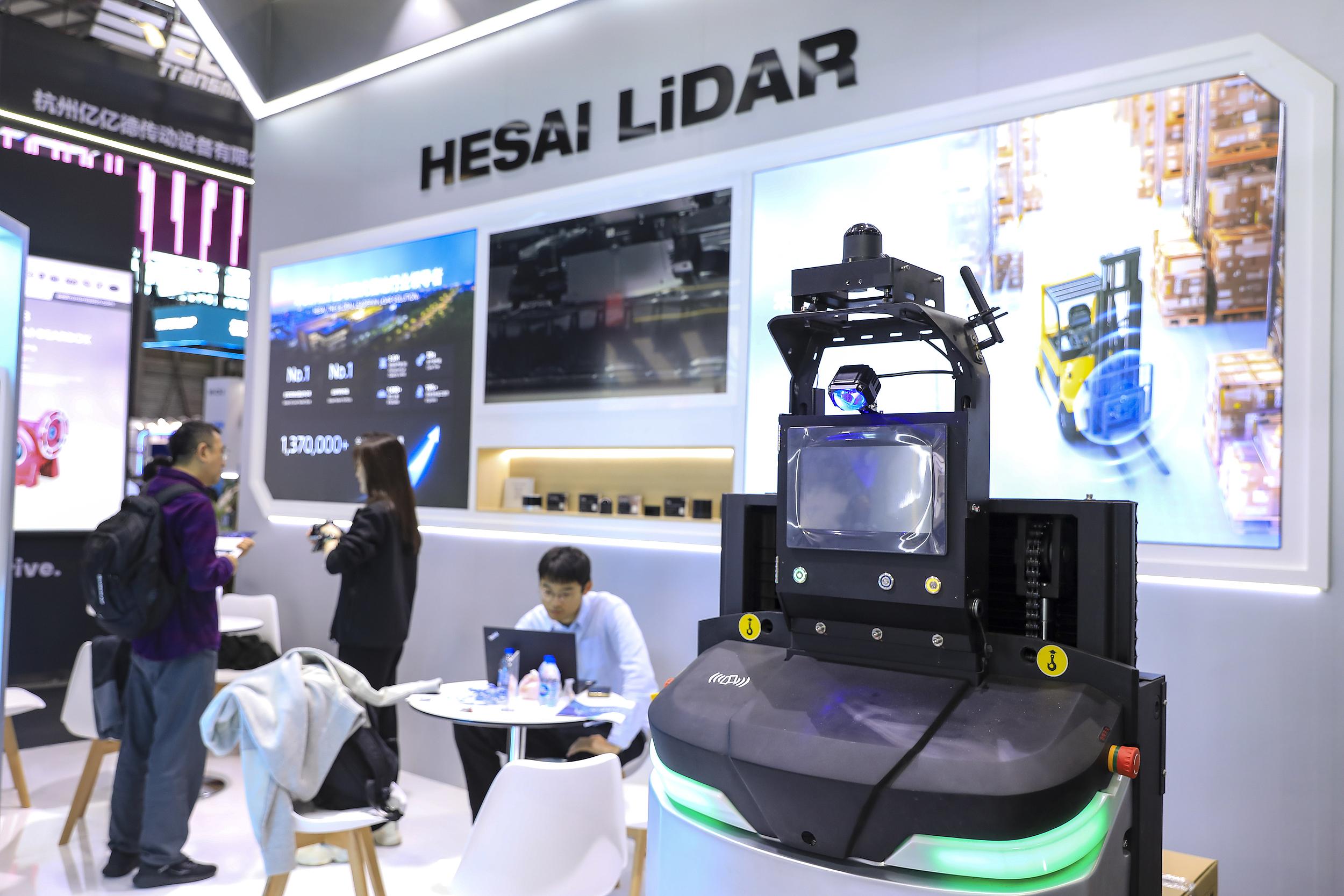
Yet market realities tell a very different story. Chinese companies have already emerged as global leaders in the lidar industry. According to estimates by French consulting firm Yole Group, in 2024 four Chinese companies — Hesai Technology, RoboSense, Huawei, and Seyond — accounted for 88 percent of the global automotive lidar market. This year alone, Huawei's lidar installations surpassed 400,000 units in the first half, while Hesai Technology produced more than one million lidar units between January and September.
These gains are not accidental. Chinese lidar companies have pursued a dual strategy of technological innovation and large-scale manufacturing. On the technology front, they have consistently broken through key technical bottlenecks and improved performance. Patent data show that Hesai Technology and RoboSense each hold more than three times as many lidar-related patents as U.S. competitors, such as Ouster and Luminar. On the manufacturing side, Chinese companies have invested heavily in automation and intelligent production. Hesai Technology's highly automated production line, which relies extensively on industrial robots, can roll out one lidar unit every 20 seconds. Its Maxwell Intelligent Manufacturing Center is the world's first facility to integrate lidar research, development, and manufacturing.
As a result, Chinese lidar products are not only technologically mature but also significantly more affordable. Companies such as Hesai Technology and RoboSense have already driven prices for some models down to around 200 USD.
The contrast with the U.S. is striking. American companies once enjoyed a clear first-mover advantage. Supported by U.S. military autonomous driving challenges, Velodyne pioneered the automotive lidar market and dominated global sales throughout much of the 2010s, at one point commanding more than 80 percent market share. Volvo strongly backed Luminar's technology development and in 2022 signed an agreement reserving 1.1 million lidar units.
However, the inability to achieve low-cost, large-scale mass production has proven to be a persistent obstacle for U.S. firms. Velodyne struggled with high prices and operational difficulties before merging with Ouster. Mercedes-Benz and Volvo later canceled their partnerships with Luminar. According to foreign media reports, Luminar's lidar products were priced at around 1,000 USD in 2024, and the company had planned to introduce a 500 USD model only by 2026.
The irony is hard to ignore. Just days after the Safe Lidar Act was introduced, Luminar — once the most highly valued lidar company in the U.S. — filed for bankruptcy on December 15. Other U.S. lidar firms are also facing mounting pressure. Ouster, now the highest-valued U.S. lidar company following its merger with Velodyne, shipped just over 7,200 units in the third quarter of 2025. Aeva, ranked second by valuation, posted quarterly revenue less than one-tenth of Ouster's during the same period.
Ultimately, the difficulties facing the U.S. lidar sector reflect deeper structural problems within American manufacturing. Without addressing long-standing challenges, forcing Chinese products out of the market through political means will only raise costs for the government and consumers alike. Even if protectionist measures temporarily create market space, U.S. companies may be unable to fill it — let alone achieve a genuine industrial revival.