

Mathematics not Only for Geniuses, but for Everyone
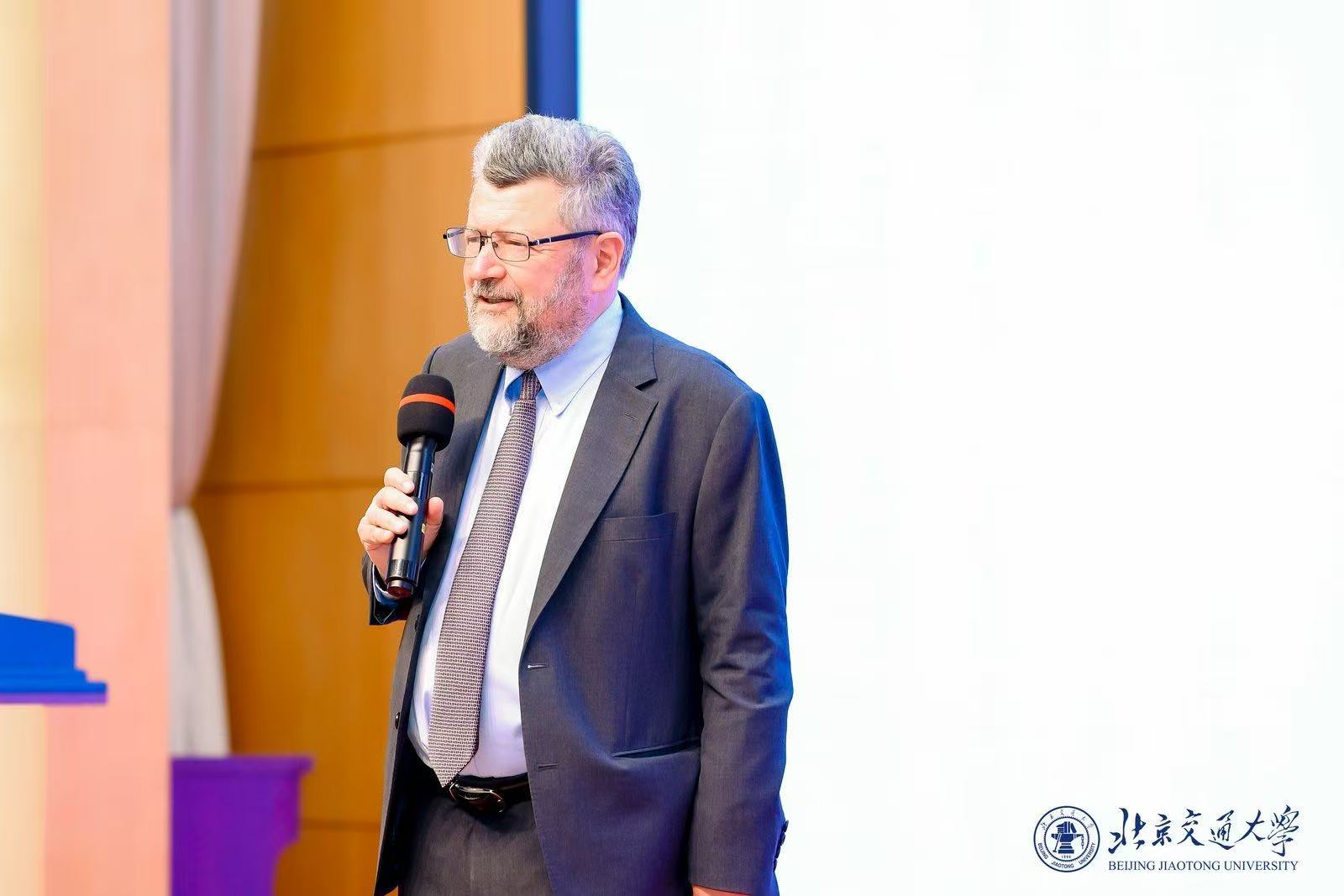
At the age of 70, renowned mathematician Professor Efim Zelmanov remains deeply passionate about teaching undergraduate students in Shenzhen in south China. Before class, he makes tea and answers questions. When he speaks about mathematics, he treats it not as a subject meant for geniuses, but as something deeply woven into everyday life.
Zelmanov received the Fields Medal for solving a century-old problem on symmetry when he was only 39. The Fields Medal is the highest honor in mathematics, presented every four years at the International Congress of Mathematicians.
Since moving to China in mid-2022, he has helped establish the Shenzhen International Center for Mathematics at the Southern University of Science and Technology (SUSTech). His goal is not only to train future medalists but to build an environment where mathematical thinking can flourish at all levels of society.
Math part of daily life
When asked how the public should understand mathematics, Zelmanov pointed to ordinary experiences. "Each time you talk on your iPhone, withdraw money from an ATM, or log in with a username, some very nontrivial mathematics is involved."
During the 2008 economic crisis in the United States, the number of mathematics majors at the University of California, San Diego, increased fivefold in a single year. "People started to think about jobs. They knew that in mathematics, they would get a job."
Over his 30 years in the U.S., he said he has never met an unemployed mathematician. "Maybe they do not exist."
He noted that AI is accelerating this trend. "AI grew out of mathematics. It operates mathematical algorithms." Computer science emerged from mathematics departments before becoming a separate discipline. "It's like a family house. When children grow, they move to their own homes."
Zelmanov expressed admiration for China's commitment to science. "I was really amazed at the level of support for mathematics and all sciences at all levels of government. People really understand it. You don't need to tell them."
Persistence defines great mathematicians
Zelmanov rejected the myth that mathematics is the realm of geniuses. While talent helps, what truly sets great mathematicians apart is endurance. "Mathematical ability is the ability to think for a very long time about some problems," he said. "The most important qualities are independence, and then they have to be very persistent, very determined in their work, because 99.9 percent of the time when a mathematician works, they don't get a result."
He cautioned against overemphasizing competitions like the International Mathematical Olympiad. Though Olympiad winners often possess talent, "Olympiad is a sport. Mathematics is partially a sport, but not entirely." Real research problems cannot be solved in a few hours. "If you can solve a problem in five hours, it doesn't mean that you will be able to solve problems that take 10 years."
Still, he acknowledged that many Olympiad participants go on to have successful careers in technology or finance. "They won't necessarily become mathematicians, but they will find their place."
He spoke warmly of his Chinese students. "The young students with whom I've had a chance to work are hardworking and full of energy. And it's pleasant to work with them."
China's rise in mathematics
Asked to assess China's progress in mathematics, Zelmanov praised the country's deep-rooted respect for education, which "goes back thousands of years." He added, "I've been in China for three and a half years, and I'm very impressed by the support that mathematics and other sciences receive from society as a whole and from all levels of government. The support is amazing."
"And China's progress has been very strong. Let's tell the truth: China has changed well. Mathematics in China is extremely strong. I'm sure that there will be Chinese Fields Medalists."
But he stressed that individual awards matter less than building a strong foundation. "It's much more important to have, in general, a high level of mathematical development in the country: top universities, top high schools, top IT companies."
He noted a significant shift: While many top Chinese students once went abroad for graduate study, "right now, top Chinese universities are very strong. And more and more young international talents are coming to China for postdoctoral training. Now that's normal."
He praised Shenzhen's ambitions. "We are right at the beginning. We are making the rules." University leaders, he said, respond quickly to suggestions, and the university president, a respected scientist, understands researchers' needs.
Looking ahead, Zelmanov hopes the Shenzhen International Center for Mathematics will become a global hub for mathematical talent. "We are trying to put the center on the world map of mathematics."