

'Future' Drives Deep-Sea Exploitation Green Progress
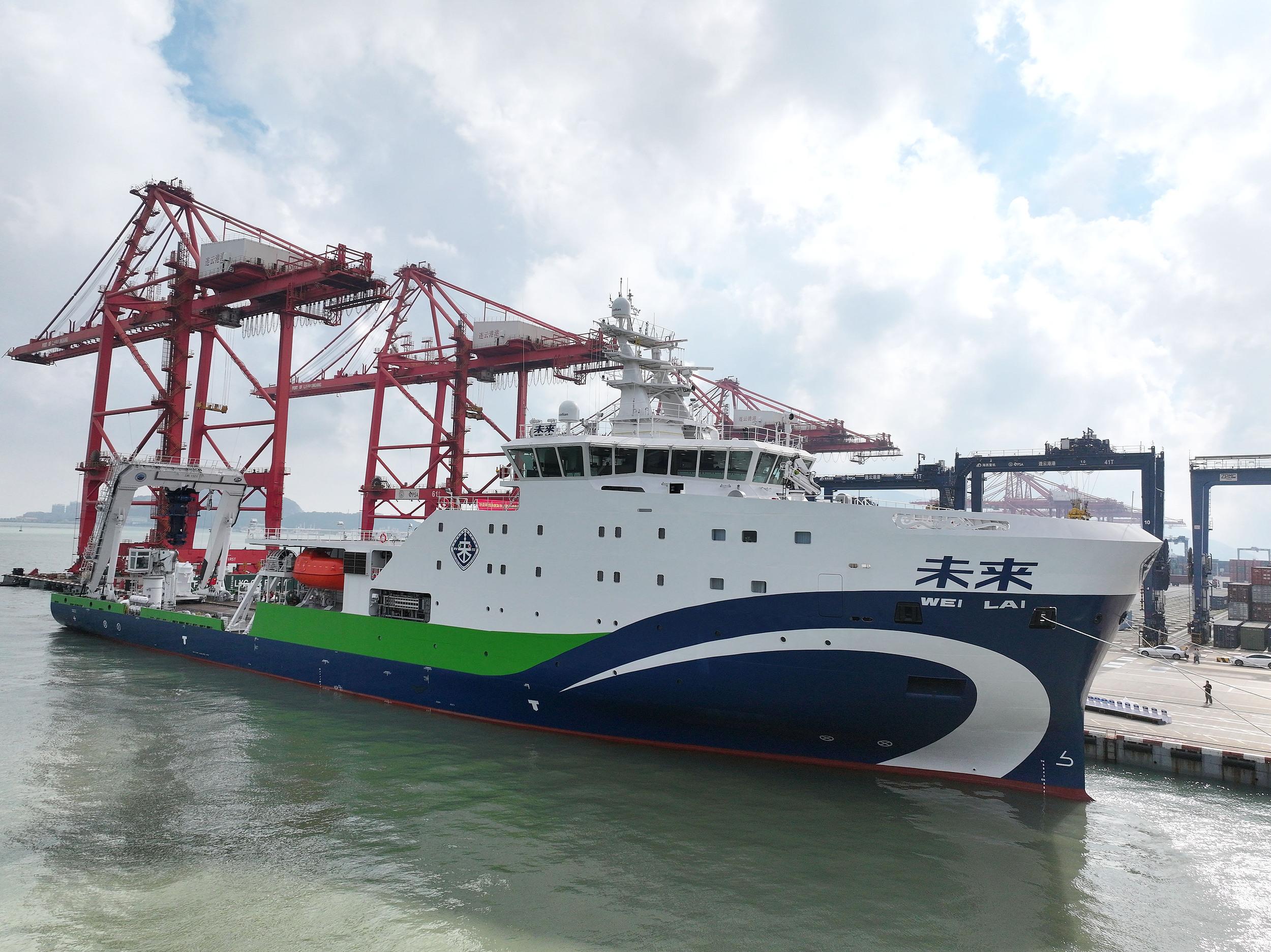
"Future", China's first deep-sea green and intelligent technology experimental vessel, recently completed its first deep and remote sea test since its delivery in July this year.
After six years of tackling key research problems, design and construction, the vessel described as a "mobile offshore laboratory," can conduct tests for new type green intelligent technologies, provide application and testing support for deep-sea equipment, and assist scientists in conducting deep-ocean surveys, said Ye Cong, director of the China Ship Scientific Research Center of the China State Shipbuilding Corporation (CSSC) and chief commander of the "Future" construction project.
Green "heart"
"Future" is equipped with four major diesel generators and six propellers.
Zhou Yu, the on-site in charge of the vessel's power system from Shanghai Marine Diesel Engine Research Institute, CSSC, said researchers tried to make the generators adjust rotational speed and output power based on the demand for electricity.
The initial mooring trials encountered challenges, one of which was the power oscillation when the four generators were in parallel operation, resulting in unstable power generation.
A container at the shipyard dock became the meeting room at that time. Researchers discussed test programs in the container and then did tests in ship cabins that were under construction.
After hundreds of parallel operation tests and multiple rounds of technical reviews and discussion, the researchers found a solution.
In April this year, a new round of mooring trials took place, and the power output of the generator sets steadily increased during parallel operation and ultimately stabilized at rated load. According to Zhou, with this set of technologies, the generators can save 456 tonnes of diesel per year, decreasing circa 1,420 tonnes of carbon emission, which equals the emission of 560 cars per year.
Elevator for submersibles
A crucial mission of "Future" is to provide support for deep-sea equipment operations. A moon pool, which is a vertical opening in the hull of the vessel that provides direct access to the sea from inside the vessel, plays an important role in operating submersibles.
Liu Yang, head of the vessel's construction supervision team, said the influence of severe sea conditions like violent storms and waves could be eased when deep-sea equipment is deployed into the ocean for operation via the moon pool.
It will also be more efficient for researchers to operate equipment for underwater observation, sampling and special operations.
Still, getting a submersible into the sea steadily via the moon pool was a challenge.
A researcher proposed securing the submersible inside the operation compartment, laying tracks from the fore cover plate of the moon pool, connecting them to the compartment's clamping device, and allowing the submersible to travel along the tracks like an elevator, directly to the ship's bottom.
This idea was impressive, but precise validation was required. For the next several months, the research team continuously improved the design of the moon pool lifting system, cover plates, tracks and clamping devices, and reinforced the moon pool structure.
The construction team meticulously refined their techniques, ultimately controlling the straightness deviation of the two tracks to within one millimeter, enabling the operation compartment to descend smoothly and unimpeded to the seabed.
Widely applicable testing and validation
As a pilot test platform, "Future" is equipped with more than 8,000 data collecting points to monitor the situation of equipment and sense the changes of surrounding environments.
Then a challenge occurred: How can a scientific, rational and efficient method be established for conducting real-vessel testing and validation of smart devices and systems from different manufacturers and with varying functionalities?
On the one hand, the researchers went through the technical specification formulated by the International Organization for Standardization and International Electrotechnical Commission and requirements by large classification societies, according to Yao Fengxiang, engineer for the development of dynamic testing systems of "Future".
On the other hand, Yao said, they clarified the function boundaries, performance index and test demands of smart equipment with equipment manufacturers and research institutes respectively. Test plans were formulated and an evaluation index system established subsequently.
The key challenge was how to efficiently collect the operation data of the tested equipment and systems.
"We developed a distributed intelligent data acquisition architecture that enables real-time synchronous collection of multi-source heterogeneous data," Yao said, adding that each task is also assigned a "timestamp" to pinpoint the equipment data associated with every task via search by time.
Currently, the dynamic testing system supports the collection, storage, computation, management and application of comprehensive shipboard data, along with seamless ship-shore data connectivity. It facilitates testing, validation, analysis and evaluation of various intelligent devices and systems.
Next, "Future" will continue pilot testing of intelligent medium-speed engines, intelligent steering gear, navigation radars and other tested equipment systems. It will provide data support for product iteration and upgrades, advancing the intelligent transformation and green development of the shipbuilding industry, said Zhang Haihua, director of the Lianyungang center of Taihu Laboratory of Deep Sea Technology Science.