

Long Ultra-high-pressure Steel Pipes Now Homegrown
By Staff Reporters
In a petrochemical plant, ultra-high-pressure steel pipes are a vital component, essential for transporting petroleum, natural gas and chemical materials.
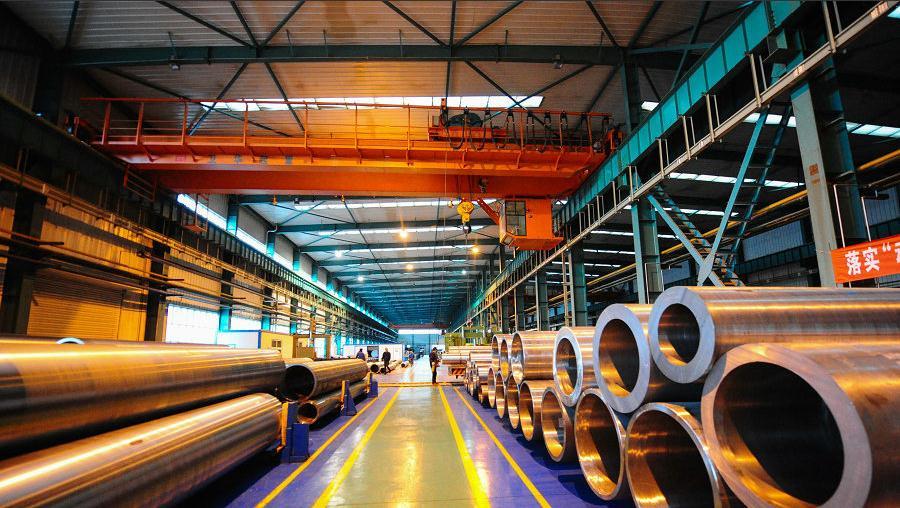
In the past, the manufacturing technology of ultra-high-pressure steel pipes over 10 meters in length was monopolized by foreign countries. However, times have changed after a Chinese company broke this bottleneck, and independently developed the 17-meter-pipe along with the capacity of mass production.
Purity of raw materials
It took 13 years to develop this 17-meter-long steel pipe, said Zhou Zhongcheng, chief engineer of the Inner Mongolia North Heavy Industries Group Co., LTD. (NHIG).
Back in 2012, the company took up the challenge of making the 17-meter long ultra-high-pressure steel pipes. Before that, it had already acquired the technology to manufacture 10-meter steel pipes.
For every additional meter, the manufacturing difficulty doubles. Zhou explained that if the length of the steel pipe increases significantly, the combined stress generated by its own weight and internal high pressure rises sharply, which requires a higher purity of raw materials.
Elements such as sulfur, phosphorus and oxygen in steel will all affect its compressive strength and uniformity. Eliminating these elements is the key to improving the purity of steel. However, oxygen is extremely difficult to remove.
The research team finally figured out a combined method. They added elements such as silicon and calcium to the molten steel to form stable oxides with oxygen. After these oxides float up, the oxygen element can be easily removed. To prevent oxygen from finding a way in during the process, the team also introduced argon gas to prevent secondary oxidation, achieving deep refining and purification of steel.
Forging long steel billets
The forging of steel billets was the next challenge. The first time, due to the slower lifting speed, the billet hardened before being fully forged to the set length, because of the rapid drop in temperature. After much deliberation, Xu Ruibing, the senior engineer at NHIG, decided to take a two-pronged approach, optimizing the processing technique and controlling the cooling time.
The core difficulty lay in temperature control. Xu believes that only by achieving precise temperature control during the processing, can engineers ensure that the billet does not cool down before being drawn to a sufficient length.
Relying on the vast amount of data in manufacturing steel pipes, the team developed an intelligent temperature control system. It models through complex algorithms, monitors the temperature of each part of the steel billet in real time, and precisely regulates the processing method based on the temperature.
The team further optimized the processing technology, and soon after that the first ultra-long billet that met the requirements was delivered.
Drilling and grinding
The steel billet is solid. It needs to be drilled from both ends to form a uniform, smooth and straight circular channel. Then, its surface is ground to finally form a steel pipe.
The allowable deviation of concentricity at both ends of a 17-meter-long steel pipe is thinner than a person's fingernail, Xu explained, to demonstrate the difficulty of the task.
Through countless attempts and improvements, the NHIG developed an extremely rigid deep hole drilling machine system, and drill pipes specifically for super-long steel pipes.
The machine system features excellent shock absorption performance and stability, effectively resisting the deflection of drill pipes caused by gravity, said Xu, adding that the drill bit is made of super-hard materials with special geometric design. Its ability and efficiency to drill deep holes in hard steel have been significantly enhanced.
The team also developed a deep hole honing machine specifically for extra-long steel pipes. Using the mentioned deep-hole drill pipe, grinding stones of different specifications were sent into the deep hole for precise honing. Eventually, the inner side of the 17-meter-long pipe ultra-high pressure pipe was polished as smooth and flawless as a mirror, signaling that it was ready for service.