

Japan's Right-Wing Forces a Threat to World Peace
The year 2025 marked the 80th anniversary of the victory of the Chinese People's War of Resistance Against Japanese Aggression and the World Anti-Fascist War. As a state defeated in World War II and a non-nuclear-weapon state party to the Treaty on the Non-Proliferation of Nuclear Weapons (NPT), Japan is prohibited from developing nuclear weapons.
However, in recent years, Japan's right-wing forces have repeatedly sought to break the three non-nuclear principles long upheld by successive Japanese governments, namely, not possessing, not producing, and not permitting the introduction of nuclear weapons.
Present Japanese Prime Minister Sanae Takaichi has been making ambiguous statements about these principles, even hinting at the possibility of abandoning them. She has also stated that the option of introducing nuclear-powered submarines should not be ruled out.
Japan is capable of producing weapon-grade nuclear materials
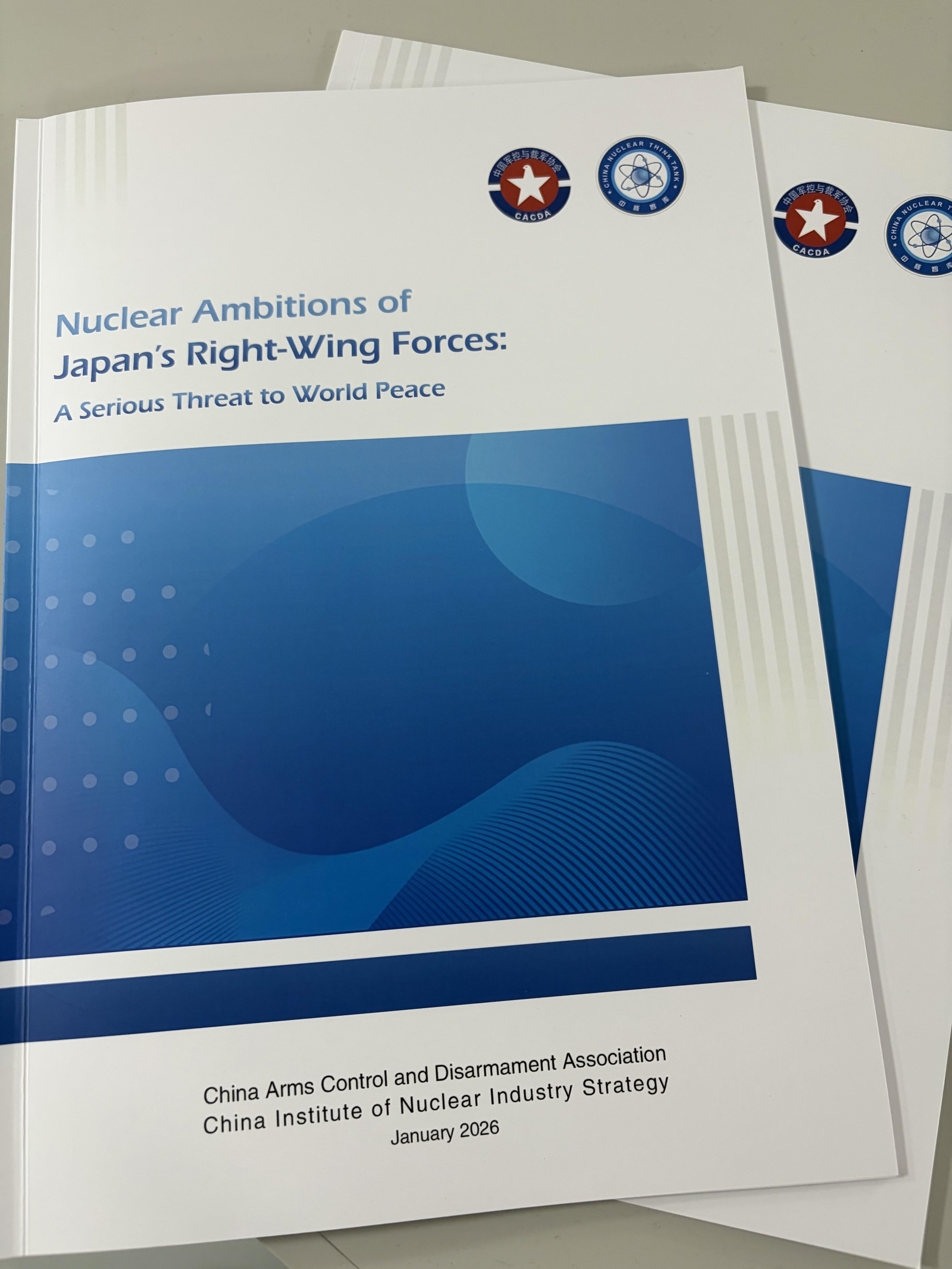
According to the report Nuclear Ambitions of Japan's Right-Wing Forces: A Serious Threat to World Peace jointly released by China Arms Control and Disarmament Association (CACDA) and China Institute of Nuclear Industry Strategy (CINIS) on January 8, Japan has plutonium stockpiles that far exceed civilian nuclear needs.
Japan's nuclear industry began to develop in the 1950s. In the field of nuclear power generation, Japan's first imported commercial nuclear power unit began operation in 1966. Thereafter, through technology introduction, assimilation, and innovation, Japan independently designed and constructed multiple types of reactors.
Prior to the Fukushima Daiichi nuclear accident in 2011, Japan operated at most 54 nuclear power reactors at the same time, with a combined installed capacity of approximately 47.5 gigawatts. This accounted for around 30 percent of the country's total electricity generation.
According to the Status Report of Plutonium Management in Japan for year 2024, released by Japan's Cabinet Secretariat Office for Atomic Energy Policy in August 2025, as of the end of 2024, Japan managed a total of approximately 44.4 tons of separated plutonium both domestically and overseas.
The expanding nuclear ambitions of Japan's right-wing forces send a dangerous signal of the revival of Japanese militarism, posing a serious threat to global peace.
The international community should be on high alert against Japan's expanding nuclear ambitions
Dai Huaicheng, secretary-general of CACDA, said Japan must fully abide by the provisions not to manufacture or acquire nuclear weapons, and not to receive whatsoever transfer of nuclear weapons or control over such weapons. However, the recent months have seen a number of dangerous attempts, including Takaichi implying the possibility of quitting the three non-nuclear principles.
These dangerous attempts, closely aligned with the inflated ambition to break free from international order, revive militarism and speed up re-militarization, are by no means isolated incidents or personal views. Rather, they are the result of long-standing, carefully orchestrated efforts by Japan's right-wing forces.
Luo Qingping, chairman of CINIS, emphasized that the international nuclear non-proliferation regime is an important part of the post-war international order. Japan's right-wing forces' attempt to revise the three non-nuclear principles and even advocate possessing nuclear weapons gravely challenges the authority and effectiveness of the NPT, undermining the international nuclear non- proliferation regime. These dangerous developments warrant high vigilance by the international community.
The report Nuclear Ambitions of Japan's Right-Wing Forces puts forward 10 recommendations. They include urging the Japanese prime minister to clarify her erroneous remarks and Japan to strictly fulfill its non-proliferation obligations and address its plutonium stockpile imbalance.
It calls on the 2026 NPT Review Conference, to take place in the United Nations headquarters in New York from April, to carefully consider this matter.
Also, the International Atomic Energy Agency must strengthen the safeguard on Japan's nuclear material and activities.
Besides, relevant countries should ensure their civil nuclear cooperation remains exclusively for peaceful purposes.
The UN chief and heads of other international organizations must express a clear stance defending the post-war international order.
The international academic community should be encouraged to strengthen research on this, providing intellectual support to maintain an international non-proliferation regime.